Does Answering Questions Beat Rereading Your Notes?
Does answering questions beat rereading your notes? Three studies say testing helped later recall more than restudying, with limits. Here is what they found and how to switch.
You have a test coming and a stack of notes. Do you read them again or quiz yourself? So, does answering questions beat rereading your notes? In the studies below, it did on tests given days later, but not on a test given minutes later. This post goes through three studies, what they do not show, and how to switch tonight with the notes you already have. If you want questions from a page fast, Study Shot turns a photo of a page into a practice quiz.
The short answer: does answering questions beat rereading your notes?
For remembering something days later, the research below says usually yes. Answering a question makes you pull the answer out of memory. Rereading puts the words in front of your eyes again. An exam asks you to do the first one.
Rereading is not useless. It is just a poor way to spend most of your study time. A sound plan is to read once to understand, then spend your time answering questions and checking what you missed.
Why rereading feels like learning
When you reread a page, everything looks familiar. You recognize the words, the headings and the diagram. Familiarity is easy to mistake for knowing.
Take a biology page on photosynthesis. Rereading it, you see "chloroplast" in a sentence about where photosynthesis happens and think, "Yes, I know that." Now close the notebook and answer this: where in a plant cell does photosynthesis take place? If you cannot say it without the page, rereading was telling you that you recognize the answer, not that you can produce it.
What the first study found: restudying won at 5 minutes, testing won later
Roediger and Karpicke published a study in 2006 that compared the two habits directly. Students studied short prose passages. Some then restudied the passage, and others took free-recall tests with no feedback, once or three times. A final test came 5 minutes, 2 days or 1 week later.
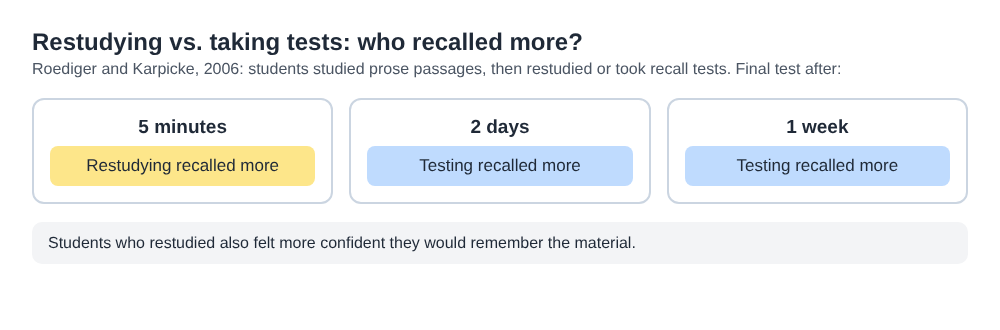
At 5 minutes, restudying gave better recall. At 2 days and 1 week, the students who had been tested remembered substantially more. The restudying students also felt more confident that they would remember the material, even though they remembered less.
That timing matters for you. If your test is in ten minutes, rereading may well help. If it is in two days, the study suggests answering questions is the better use of the time.
What two more studies found about testing and confidence
In 2008, Karpicke and Roediger had students learn foreign language vocabulary through repeated study and test rounds. Once a student had correctly produced a word, it was handled in one of four ways: kept in both study and test, studied only, tested only, or dropped. Repeated studying after that point had no effect on recall at a delayed test. Repeated testing had a large positive effect. The students' predictions of how they would do were also uncorrelated with how they actually did.
In 2011, Karpicke and Blunt compared retrieval practice with a popular alternative, studying a science text and building a concept map. Practicing retrieval produced greater gains in meaningful learning. The advantage showed up on questions that tested comprehension and required inferences, and even when the final test was to make concept maps.
What these studies do not show
Be careful with what you take from this. These are research studies, not a promise for your next exam.
- The 2006 study used free recall, where students write down what they remember. The 2008 study used vocabulary. Study Shot's questions are multiple choice, so none of these studies tests the app itself.
- The studies compare testing with restudying, not with every other way to study.
- They report group results. They do not say any one student will gain.
For more on how researchers tested quizzing in real classrooms, read whether practice quizzes raise exam scores and what studies found.
When rereading still has a place
Do not throw out your notes. Rereading helps in a few cases:
- The first pass. You cannot recall what you never learned. Read first, then test yourself.
- After a miss. When a question shows a gap, go back to that part of the page and read it closely. That is rereading with a purpose.
- A very short wait. The 2006 study found restudying ahead at 5 minutes.
The pattern is to read to understand, answer to find the gaps, then reread only what you got wrong.
How to answer questions instead of rereading with Study Shot
You do not need new materials. A textbook page, your notes or a whiteboard photo will do.
- Pick one page. A single page gives you a focused quiz.
- Photograph it. Choose Make a new quiz, then Take photo or Choose photo. Hold the page flat and fill the frame. The guide on taking a good photo of a page has more tips.
- Choose how many questions. You can pick 5, 10, 15 or 20. The default is 10.
- Choose a level. Tiered is the default and climbs from basic to advanced. Advanced asks you to apply and predict in new situations.
- Press Create questions. It can take up to a minute.
One honest note: the questions are written by an AI model and can contain mistakes. The explanation helps you check an answer against your page. If a question looks wrong, use Report a problem with this question.
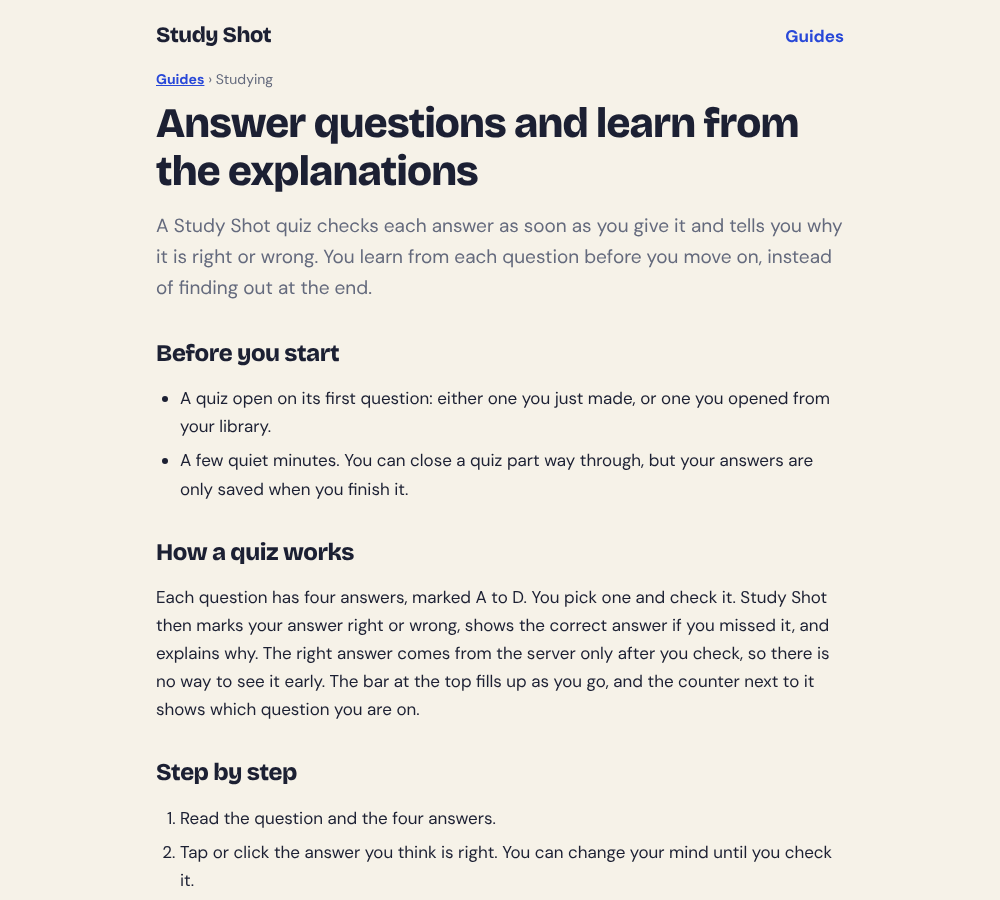
Multiple choice also makes it tempting to pick the option that looks familiar, which is the same trap as rereading. The guide to answering and learning from explanations gives the fix: say the answer to yourself before you look at the options.
A 20-minute routine to replace rereading tonight
This is a suggestion, not a method the studies tested. It assumes you have read the page once.
- Minutes 0 to 2: set up. Photograph the page and create a 10-question Tiered quiz.
- Minutes 2 to 12: answer. One question at a time, say your answer before you see the options. Press Check answer, read the explanation, then press Continue.
- Minutes 12 to 15: read your results. You see a percentage, a grade and a score for each level. If the advanced score is low and the basic score is high, you know the facts but not yet how to use them.
- Minutes 15 to 20: fix the misses. Open Look at these again, which lists each missed question with Your answer and Right answer. Reread only the part of your notes that covers them.
The guide on results and retakes suggests retaking a quiz a day or two later, since getting it right after a break is a better sign that you have learned it. Retaking uses no credits. For how many retakes make sense, see how many times you should retake a practice quiz.
Frequently asked questions
Is answering questions better than rereading right before a test?
Not necessarily. In the 2006 study, restudying gave better recall on a test 5 minutes later, and testing won on tests 2 days and 1 week later. Use questions in the days before, and keep any last-minute reread short.
Why does quizzing myself feel less certain than rereading?
In the 2006 study, students who restudied felt more confident but remembered less. A missed question shows a real gap, which rereading can hide.
Can I make practice questions from my own notes?
Yes. In Study Shot you photograph a page of your notes, a textbook page or a whiteboard, and it writes multiple-choice questions about it. It runs in the web browser on a phone or a computer.
Do I lose credits when I retake a quiz?
No. Taking a quiz, retaking it and taking a quiz someone shared with you use no credits. Writing a new quiz does.
Get started
Pick the page you were about to reread tonight. Photograph it, make a 10-question quiz and answer before you look at the options. Then reread only what you missed. For a walkthrough of every screen, the guide on making your first quiz helps.
Try Study Shot: it is free to start. Photograph the page you are studying tonight and get practice questions on it, from basic to advanced, with every answer explained.