Do Practice Quizzes Raise Exam Scores? What Studies Found
Do practice quizzes raise exam scores? Two classroom studies and two lab studies say quizzing helped, with limits. Here is what each found and how to use it.
Do practice quizzes raise exam scores? What studies found, in short: quizzing helped in the classroom studies below, but no study can promise a result for one student. This post reads four research abstracts and says what each does and does not show. Then it gives a routine for using quizzes before a test.
The short answer: do practice quizzes raise exam scores? What studies found
In the studies below, yes, quizzing went along with better results. In a middle school experiment, quizzed material did better on chapter and semester exams than material that was not quizzed. In a university biology course, students who re-quizzed near exam time did better on two cumulative exams than their earlier preparation predicted.
Both come with limits, and the rest of this post spells them out. The four studies are a small sample of a large field. They are not a promise for your course.
If you want to try quizzing on your own pages, Study Shot turns a photo of a page into a practice quiz. More on that near the end.
What the first lab study found about delayed tests
Roediger and Karpicke published an often-cited experiment in 2006. Students studied short prose passages. Then some of them took one or three free-recall tests, with no feedback, and others restudied the passage the same number of times. A final test came 5 minutes, 2 days or 1 week later.
At 5 minutes, restudying gave better recall. At 2 days and 1 week, the tested students remembered substantially more. Repeated studying also made students more confident that they would remember, even though they remembered less.
That is why rereading can feel like the better plan the night before. The study measured recall of prose passages, not multiple-choice questions, and the students were not sitting a course exam. But it shows why the delay matters: an exam is days away, not minutes.
What a middle school classroom study found
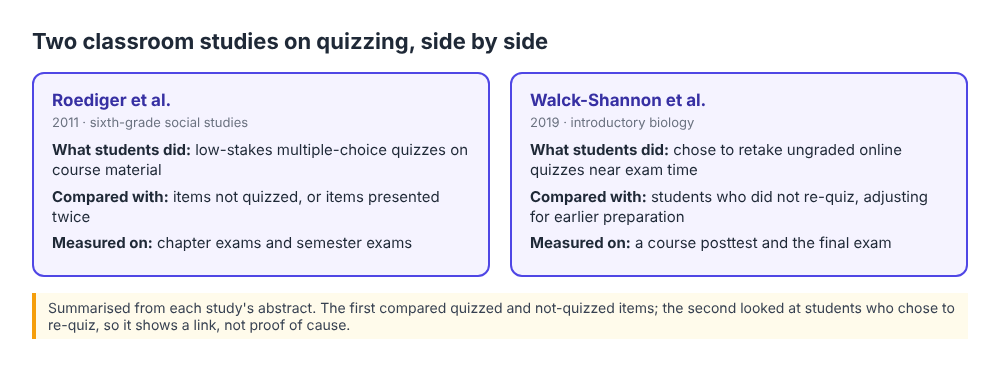
A lab is one thing. A real course with graded exams is another. In 2011, Roediger, Agarwal, McDaniel and McDermott ran three experiments with sixth-grade social studies students at a suburban middle school. The material was the course's own, and some of the measures were the exams students received grades on.
Students took low-stakes multiple-choice quizzes. Their performance on chapter exams and semester exams improved for quizzed material, compared with material that was not quizzed or that was shown twice. In the third experiment, students took one multiple-choice quiz in class and were encouraged to quiz themselves outside class with a web-based system. The positive effect on chapter and semester exams showed up there too.
The authors describe their results as adding to a growing body of evidence that retrieval practice in the classroom can boost academic performance. Note the age group: these were sixth graders on one school subject, so the result does not tell you the size of the gain for a university course or a different subject.
What a university biology study found about re-quizzing
Walck-Shannon, Cahill, McDaniel and Frey looked at an introductory biology course in 2019. Students took a graded quiz first. One to three weeks later, the quiz was reopened online, ungraded, near exam time. Taking it again was voluntary.
When the researchers controlled for preparation, meaning performance in an earlier STEM course and what students already knew of biology, re-quizzing predicted better results on two cumulative exams: a course posttest and the final exam.
There was also a preliminary finding. For the final exam, students with lower performance in a previous STEM course seemed to benefit more. But they were also less likely to re-quiz.
The word that matters is "predicted". The students chose whether to re-quiz, so this shows a link and not proof that re-quizzing caused the better scores. Students who choose to practise may differ in ways the controls did not catch. The result is still useful, because the quizzes were the kind a student can reopen and take again before an exam.
Why multiple choice needs feedback
Many practice quizzes are multiple choice, so one more study matters. Butler and Roediger reported in 2008 that multiple-choice testing enhances retention of what is tested. But the wrong options, which they call lures, can expose students to misinformation and lead them to pick up false knowledge.
Their test of feedback gave students a multiple-choice test with immediate feedback, delayed feedback or none. Compared with no feedback, both kinds raised the proportion of correct answers and cut the proportion of lure answers on a later cued recall test. The authors' advice: provide feedback when using multiple-choice tests.
In practice, that means a quiz where you never see the right answer is a weaker study tool. Read the correct answer and the reason every time. We cover this in more depth in why multiple-choice practice helps you learn, and the basic idea of retrieval in the testing effect explained for students.
What these studies do not show
- They give no number you can count on. The abstracts report better results, not a score you should expect. This post names no percentage because none of the four abstracts supports one for you.
- They are four studies. The field is far bigger. These four were chosen because their abstracts were read in full while writing this post.
- The re-quizzing result is a link. Students chose to practise, so you cannot read it as cause and effect.
- The test and the exam differ. The lab study used recall of prose. The classroom studies used multiple-choice quizzes and exams from real courses. If your exam is mostly essays or worked problems, add practice in that format too.
A routine for using practice quizzes before a test
This routine is a suggestion that follows the studies' general direction, not a method any of them tested. Say you have a biology chapter on cellular respiration and a test in ten days.
- Quiz yourself after reading the page once. Answer every question before checking anything. A guess still makes you pull something from memory.
- Read each explanation. Put more time into the misses than the hits, as feedback is the part the multiple-choice study stresses.
- Keep a short list of what you missed. It becomes your study guide for the next few days.
- Retake a day or two later. This follows the lab study's delay finding and the university study's re-quizzing, which came days to weeks after the first attempt. Our post on how many times to retake a practice quiz gives a stop rule.
- Retake again near the test. The university study looked at quizzes reopened near exam time.
How Study Shot fits into this routine
The slow part of quizzing is writing good questions. Study Shot does that step. You photograph a page from a textbook, your notes, a handout or a whiteboard, and an AI model writes multiple-choice questions about it. Each has four choices and one right answer. It runs in a web browser on a phone or a computer, and it is free to start.
- Choose 5, 10, 15 or 20 questions. The default is 10. A level is also your choice. Tiered is the default: a ladder from basic to advanced.
- Answer, then check. Pick an option and press Check answer. The app says Correct! or Not quite., shows the right answer and gives a short explanation. That is the feedback step.
- Look at your misses. The results screen lists each missed question with Your answer and Right answer under Look at these again. It also gives a score for each level, so you can see whether the basics or the harder questions are the problem.
- Retake from your library. Quizzes are saved with your page photo and best score. Retaking takes the same questions again and uses no credits. The results guide suggests retaking a day or two later, not only straight away.
A worked example: photograph the cellular respiration page, choose 10 questions on Tiered and take the quiz that evening. Read the explanations for each miss and write the missed topics on a list. Two days later, open the quiz from your library and retake it. If the same questions still trip you up, spend your next session on those. The guide to making your first quiz shows the steps in the app.
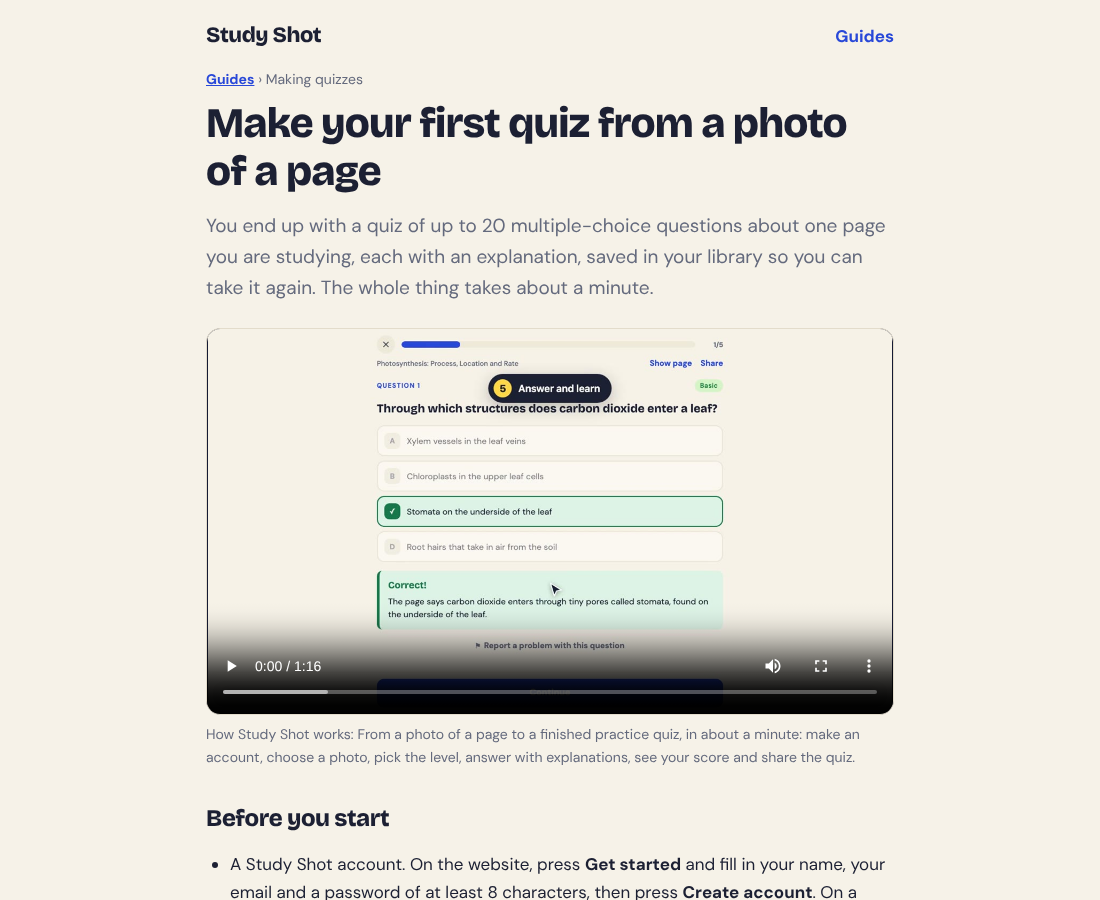
The questions are written by an AI model and can contain mistakes. The explanation helps you check an answer against your page, and Report a problem under a question lets you flag one. Study Shot makes multiple-choice questions only, so practise essays or worked problems separately if your exam needs them. For more on checking questions, see how accurate AI-written practice questions are.
Frequently asked questions
Do practice quizzes really improve exam results?
In the classroom studies read for this post, quizzed material did better on later exams, and re-quizzing predicted better cumulative exam scores. Neither abstract promises a gain for you or says how big it will be.
Is quizzing better than rereading?
In the 2006 lab study, restudying won on a test 5 minutes later, but testing won on tests 2 days and 1 week later. The study used recall of prose, so treat it as a reason to test yourself and not as a rule for every exam.
Does the quiz need feedback?
The 2008 study on multiple-choice testing found that feedback raised correct answers and reduced lure answers on a later test. Always read the right answer and the reason after each question.
Can a multiple-choice quiz help if my exam is not multiple choice?
It can help you recall facts and ideas, but none of these studies tested that. For essays or worked problems, also practise in the exam's own format.
Get started
If you want to see what quizzing does for you, take a photo of tonight's reading and quiz yourself on it.
Try Study Shot: it is free to start. Photograph the page you are studying tonight and get practice questions on it, from basic to advanced, with every answer explained.