Does Quizzing Yourself Help You Learn Vocabulary in a New Language?
Two lab studies of new-language words found that trying to recall a word first beats seeing it again. What they found, and a simple quiz routine for a vocabulary page.
Does quizzing yourself help you learn vocabulary in a new language? Two lab studies of new-language words say yes: trying to recall a word before you see or hear the answer helped people remember it better than seeing it again or repeating it. This post explains what those studies did, what they do not prove, which way round to quiz yourself, and a simple routine for one vocabulary page. You can do it on paper, or turn a photo of the page into a practice quiz with Study Shot, a web app that writes multiple-choice questions from a picture of a page.
Does quizzing yourself help you learn vocabulary in a new language? The short answer
Yes, in the two studies described below. Learning a word has two halves. You take the word in, and later you have to get it back out when you read, listen or speak. Rereading a word list works on the first half. A quiz makes you do the second half while you still have time to fix what is missing.
A quiz also sorts your list for you. Rereading treats every word the same. A quiz shows which words you already have and which ones come up blank, so your next ten minutes go to the words that need them.
What two vocabulary studies found
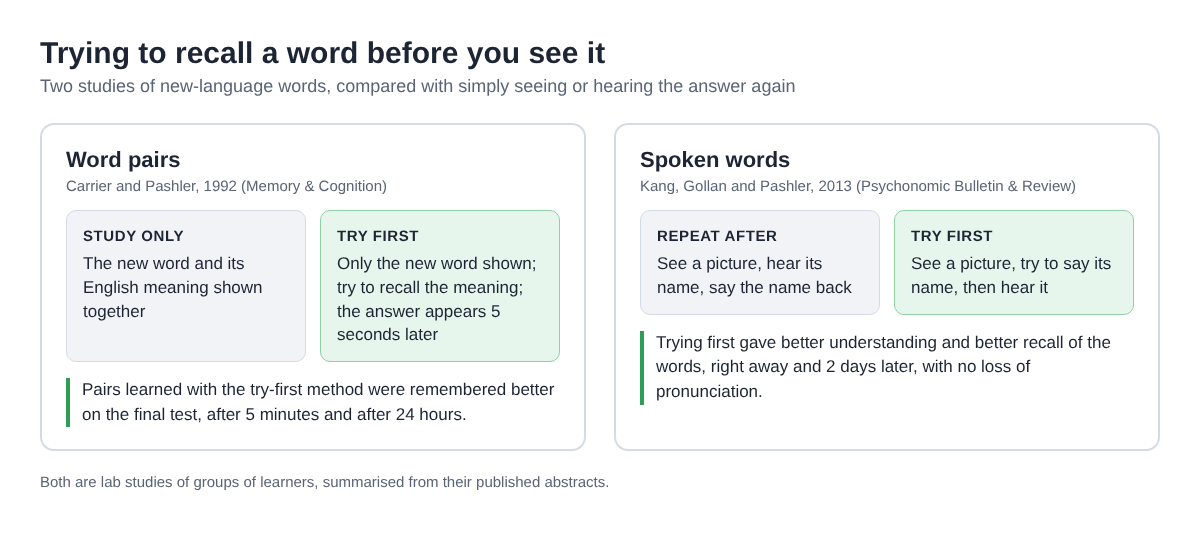
The first study is old and simple. Carrier and Pashler, at the University of California, San Diego, published four experiments in Memory & Cognition in 1992. In one of them, people learned pairs of Eskimo and English words in two ways. In the study-only way, they saw both words of a pair together. In the try-first way, they saw only the Eskimo word, tried to recall the English one, and saw the answer about 5 seconds later. On the final test, pairs learned the try-first way were remembered better, and the gain looked about the same whether the test came after 5 minutes or after 24 hours.
The authors also ruled out the easy explanation. You might think trying to recall a word only helps because it shows you the word one more time. Their results rejected that idea: the act of retrieving the word did something that another look at it did not.
The second study looked at spoken words. Kang, Gollan and Pashler, also at the University of California, San Diego, published it in Psychonomic Bulletin & Review in 2013. Learners saw pictures of objects and heard their names in a new language. In the imitation condition, they heard each name and then repeated it aloud, a common drill in classes. In the retrieval condition, they tried to say the name before they heard it. On a test right after training, and in a second experiment two days later, trying first gave better understanding of the words and better ability to say them, with no loss in how well they were pronounced.
What these studies do not tell you
Both are lab studies of groups of learners, summarised here from their published abstracts. They used word pairs and picture names, tested over minutes and days, not a whole course over a term. They do not test any app, and they do not say how many words a day to learn or exactly when to review.
What they do support is one habit: before you look at the answer, try to produce it. That is the part worth building into every way you study vocabulary, whether you use paper, flashcards or a quiz on your phone.
Which way round to quiz yourself
You can quiz a word in two directions:
- New language to your own: you see la ventana and recall "window". This is the reading and listening side.
- Your own language to the new one: you see "window" and recall la ventana. This is the speaking and writing side.
In Carrier and Pashler's word-pair experiment, people saw the new word and recalled its English meaning. In Kang and colleagues' study, they saw a picture and had to produce the new word itself. Both directions involved recall, and both showed a benefit. A sensible plan, and this is a suggestion rather than a finding, is to start with new language to your own for brand new words, and switch to your own language to the new one once a word feels steady.
How to turn a vocabulary page into a quiz
Study Shot's guide to getting your quiz in another language has a tip written for exactly this: to learn vocabulary in a new language, photograph a page in that language and get the quiz in your own. You practise reading the page, and the explanations make sense straight away.
Here is how one page goes, step by step.
- Photograph this week's vocabulary page from your textbook, your notes or a worksheet. Hold the page flat and fill the frame.
- Choose how many questions: 5, 10, 15 or 20. Ten is the default.
- Choose a level. Basic is described as "Key terms, facts and definitions", which suits new words. Tiered, the default, is a ladder from basic up to advanced.
- Under Language, pick your own language from the list of 50. The questions, answers and explanations are written in it, and the app's screens stay in English.
- Press Create questions. It can take up to a minute.
Each question has four choices. To keep the recall effort the studies point to, cover the choices or look away and say the answer to yourself before you read the options. Then pick one and press Check answer. You see Correct! or Not quite., the right answer, and a short explanation.
The questions are written by an AI model and can contain mistakes, so read the explanation against your page. During the quiz, Show page brings up your photo. If a question looks wrong, use Report a problem with this question under it.
A worked example: one Spanish page, three short sessions
Say your Spanish class gave you a page of 20 household words, from la ventana to el armario. The days below are a suggestion, not a schedule from a study.
Day 1. Photograph the page, pick 10 questions at Basic, set the language to English, and take the quiz. On the results screen you see your score, a grade, and Look at these again, which lists each missed question with your answer and the right one. Say each missed word aloud in Spanish, then write it once.
Day 2. Open the quiz from your library, where it is saved with its page photo and your best score, and press Retake quiz. Retaking a quiz uses none of your monthly study shots. Before each question, try to say the Spanish word or its meaning first.
Later in the week. Make a new quiz from the same photo, this time with the language set to Spanish, so the questions themselves are reading practice in the new language. If you get a word wrong, that is useful: the post on why getting an answer wrong can help you remember it explains why a miss followed by the right answer is worth having.
For how often to come back to a saved quiz, see how many times you should retake a practice quiz, and for what each part of the results screen means, the guide to results, your library and retakes.
Frequently asked questions
Are flashcards the same as quizzing yourself?
They can be, if you really try to recall the answer before you turn the card. In both studies above, the benefit came from attempting the word first; turning the card straight away is closer to seeing it again.
Does it matter if I get the word wrong when I try first?
In Carrier and Pashler's try-first method, people saw the right answer a few seconds after their attempt. So attempt the word, then always check the answer and read the explanation.
Can Study Shot write the quiz in the language I am learning?
Yes. You can pick any of 50 languages for the questions, answers and explanations, whatever language the page is in. The app's buttons and screens stay in English.
Is multiple choice enough for learning vocabulary?
Multiple choice checks whether you recognise the right word. To add recall, try to say the answer before you read the four choices, and say missed words aloud after the quiz.
Get started
Find the vocabulary page you are working on this week. Photograph it, pick 10 questions at Basic, choose the language you want the quiz in, and take it tonight. Retake it tomorrow. If you are new, the guide to making your first quiz walks through each screen.
Try Study Shot: it is free to start. Photograph the page you are studying tonight and get practice questions on it, from basic to advanced, with every answer explained.