Why Getting an Answer Wrong Can Help You Remember It
A wrong answer is not wasted study time. See what two memory studies found about errors and feedback, and a four-step routine to turn each miss into a lasting win.
You pick an answer, feel sure about it, and then find out it was wrong. It stings. But why getting an answer wrong can help you remember it is something memory researchers have tested directly, and two studies point the same way: a miss that you then see corrected can be worth more than a lucky hit. This post explains what those studies found, what they do not tell us, and how to use your mistakes on purpose.
Why getting an answer wrong can help you remember it
When you reread a page, everything looks familiar. A practice question works differently. You have to commit to an answer, and if it is wrong, you find out right away, with the correct answer next to your own.
That moment does three useful things:
- It shows you which idea you thought you had but did not.
- It gives you a small, clear gap to fill, instead of a vague worry about the whole chapter.
- It puts the correct answer right after your own attempt, so you can compare the two.
The catch is that all of this depends on you reading the correction. A wrong answer you shrug off teaches you almost nothing. A wrong answer you look at closely can teach you a lot.
What the research says about wrong answers and memory
This post rests on two study abstracts, opened and read for this post. They are lab studies, so treat them as a good reason to try the habit, not as a promise of a result.
The first is by Kornell, Hays and Bjork, published in 2009. They asked people questions they could not possibly know, such as a question about a made-up peace treaty, and in other experiments asked them to guess a word linked to a cue word. In one condition, people tried to answer before the answer was shown. In the other, the question and answer appeared together. The authors report that these unsuccessful attempts enhanced later learning. They suggest that taking challenging tests, instead of avoiding errors, may be one key to effective learning. You can read the abstract on PubMed.
Notice what the study is not about. It used trivia and word pairs, not textbook pages, and it does not say that errors alone help. The answer was shown afterward in every case. That matches the broader idea of the testing effect: being quizzed can help you keep material.
The hypercorrection effect: confident mistakes get fixed
The second study is by Butterfield and Metcalfe, published in 2001. You might expect that the answers you were most sure about would be the hardest to fix, because a strong wrong memory should get in the way. The authors expected that too. They found the opposite: errors made with high confidence were the most likely to be corrected on a later retest. They call this being hypercorrected. The abstract is on PubMed.
The abstract does not explain why this happens beyond noting that people seem to have a good sense of what is correct once they see it. So this post does not give a reason either. The practical point is enough: a confident miss is not a lost cause.
Here is how it might look. Take a biology page on photosynthesis, and a question like the sample one on the Study Shot home page:
Where in a plant cell does photosynthesis take place? A) In the mitochondria, B) In the chloroplasts, C) In the nucleus, D) In the cell wall.
You pick A without a second thought, because you remember mitochondria from class and it feels right. The answer comes back as Not quite., with B as the correct choice and a short explanation. You were sure, so the correction is hard to ignore. Based on the hypercorrection finding, that is a miss worth keeping, not one to be embarrassed about.
Guessing first: what a failed attempt does for you
The Kornell study also hints at something you can use. In it, people who tried an answer before seeing it learned more than people who simply read the answer. You can borrow that with your own pages. Photograph a page you have not studied closely, take a short quiz on it, and see what you miss. Then read the page and compare.
The attempt has to be real. Do not click at random. Think, commit to an answer, then look. If you want a plan for a whole chapter, see how to study a whole chapter one page at a time.
How to learn from a wrong answer in 4 steps
These steps are practical advice built on the findings above, not a method taken from a study. Try them for a week and see if they help.
- Stop and read the right answer. Do not rush to the next question. Read the correct option and the explanation in full.
- Name why you chose the wrong one. Was it a mixed-up term, a half-remembered fact, or a guess? Say it in a sentence. "I mixed up where energy is captured with where it is released" is more useful than "I got it wrong."
- Say the right answer in your own words. Look away from the screen and explain it out loud or on paper, as if teaching a friend. If you cannot, read it again.
- Test it again later. Come back after a break rather than right away. A second attempt shows whether the fix held.
Common mistakes that waste a wrong answer
A wrong answer is only useful if you act on it. These habits throw it away:
- Skimming the explanation. If you only note which letter was right, you learn the letter, not the idea.
- Calling every miss a silly slip. Sometimes it is. Often it is a real gap. Check before you decide.
- Retaking at once. If you still remember the letters from a minute ago, a perfect score tells you little.
- Guessing without thinking. A random click is not a real attempt, so there is nothing to correct.
- Trusting every question blindly. Questions written by AI can contain mistakes, so if an answer still looks wrong after you think it through, check your page. We cover this in how accurate AI-written practice questions are.
How to practice with your mistakes using Study Shot
Study Shot turns a photo of a page into a practice quiz, and it checks and explains each answer as you go. Here is a workflow that puts your misses to work.

1. Make the quiz
Choose Make a new quiz, then Take photo or Choose photo. Hold the page flat and fill the frame. Start with 10 questions, the default. Tiered is the default level and runs from basic to advanced, which is a good way to find where your knowledge starts to break. The guide on taking a good photo of a page covers the photo.
2. Answer, check, and read
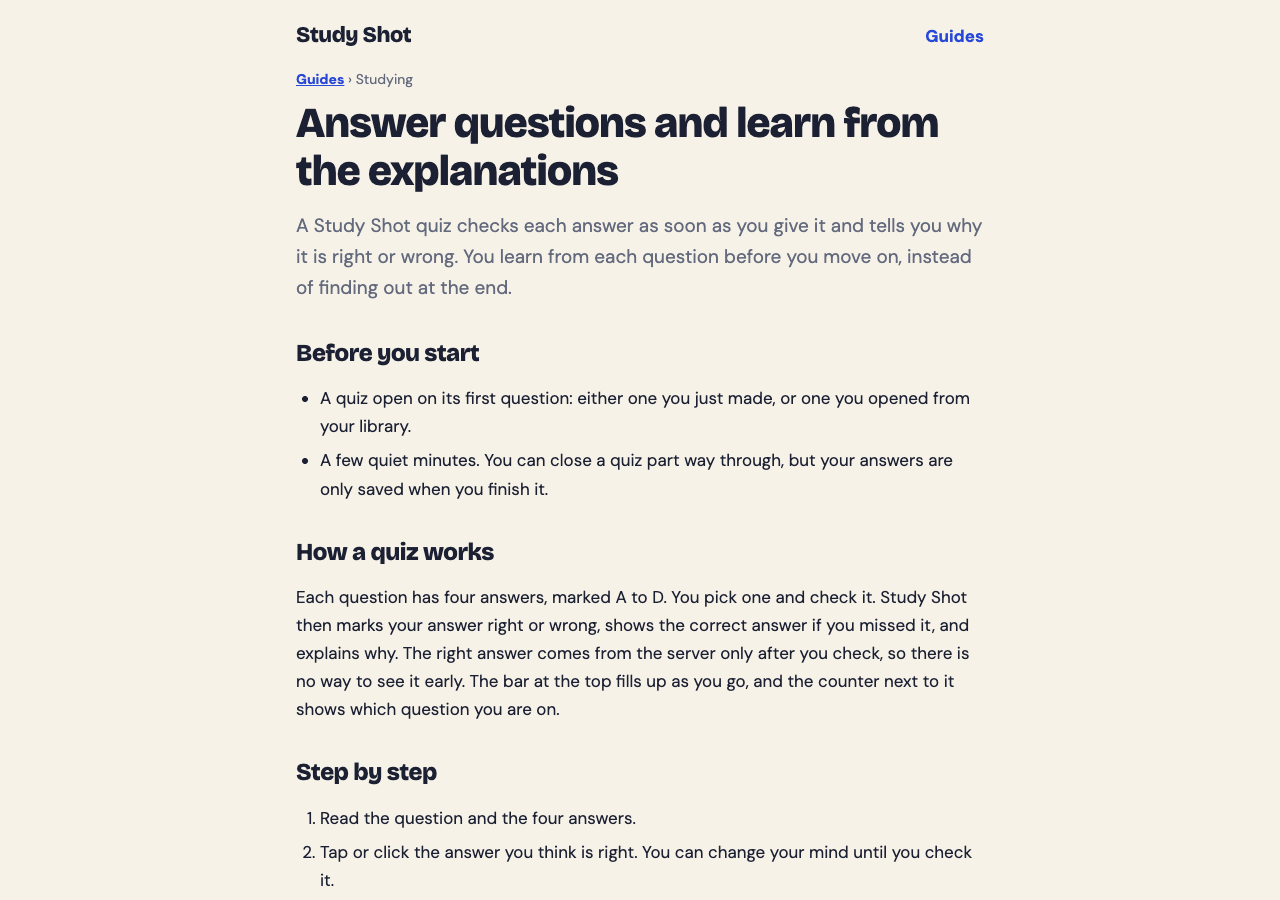
Pick an option and press Check answer. You see Correct! or Not quite., the right answer, and an explanation of one to three sentences. When you see Not quite., do steps 1 to 3 from the routine above before you press Continue. Press Show page if you want to look at your photo during the quiz. The explanation helps you check the answer against your page.
3. Review the misses
At the end, the results screen shows your score and grade, plus a right and total score for each level. Below that, Look at these again lists each question you missed, with Your answer and Right answer. That pairing shows exactly what you chose and what you should have chosen. If your misses bunch up in the Advanced level, the basics may be fine and the applying part is what needs work.
4. Retake later
Your quiz is saved in your library with your best score. Come back after a break and press Retake quiz. Taking and retaking a quiz use no credits. The grades run from Needs another try (below 50%) through Getting there and Good up to Mastered (90% and up). For a full plan, see how to retake a quiz until you master a page.
If a question looks wrong or unclear, use Report a problem with this question under it and pick one of the four reasons.
Frequently asked questions
Is it better to get a question wrong than to skip it?
The Kornell study found that a failed attempt before seeing the answer helped later learning more than reading the answer alone. So commit to an answer, then read the correction.
Why do the answers I was sure about and got wrong often stick?
Butterfield and Metcalfe found that errors made with high confidence were the most likely to be corrected on a retest. Their abstract does not say why, so nobody should claim a reason from it.
How soon should I retake a quiz after missing questions?
Wait for a break rather than retaking right away. At once, you may just remember the letters you saw a minute ago instead of the ideas behind them.
Does this mean errors alone help me learn?
No. In the studies above, the right answer was shown after each attempt. A miss helps when you look at the correction and think about it.
What if I think the quiz question is wrong?
AI-written questions can contain mistakes. Check the explanation against your page, and use Report a problem with this question if it still looks wrong.
Get started
Pick one page you are studying this week, photograph it, and take a short quiz. Treat every Not quite. as a pointer to what to study next, not as a failure. For a short routine before a test, try a 30-minute practice routine for the night before.
Try Study Shot: it is free to start. Photograph the page you are studying tonight and get practice questions on it, from basic to advanced, with every answer explained.