Does Taking a Quiz Before You Read a Chapter Help You Learn?
A quiz before you read a chapter can help you remember what it asked, even when you guess wrong. What three studies found, and how to use it page by page.
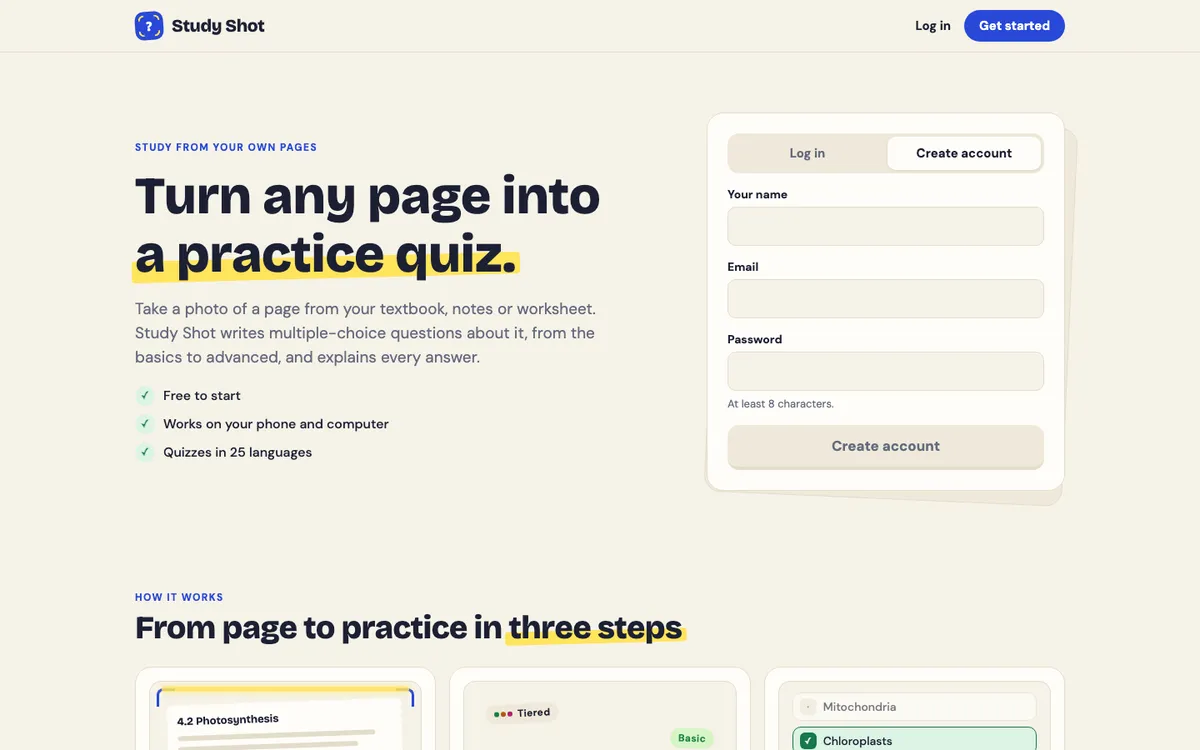
Does taking a quiz before you read a chapter help you learn? For the points the quiz asks about, the research says yes, even when you get those questions wrong. A quiz before you read a chapter is called a pretest, and it has a limit worth knowing: it mostly helps with what it asked, so it works best next to a second quiz after the reading. This post shows what three studies found and how to pretest a page with Study Shot, which turns a photo of a page into a practice quiz.
A quiz before you read a chapter: the short answer
A pretest feels backwards. You have not read the page, so you cannot know the answers. That is the point. You are not trying to score well. You are trying to meet the questions before you meet the text.
Here is what the studies below support:
- Trying to answer a question before reading helped people remember that answer after reading, more than spending the same time reading.
- It helped even on questions people got wrong on the pretest.
- In a real class, the benefit stayed with the questions that were asked. The rest of the lesson did not get the same boost.
- A quiz after the lesson did more for memory a week later than the pretest added.
What a pretest is, and what it is not
A pretest is a short set of questions on material you are about to study. You answer them as well as you can, then you read. It is not a test of what you know. A low score is the expected result.
It is also different from the testing effect you may have read about, where you quiz yourself on something you already studied. That version asks your memory to bring back an answer. A pretest asks you to try before there is anything to bring back. If you want the background on why a missed answer can still help, our post on why getting an answer wrong can help you remember it covers that side.
What three studies found
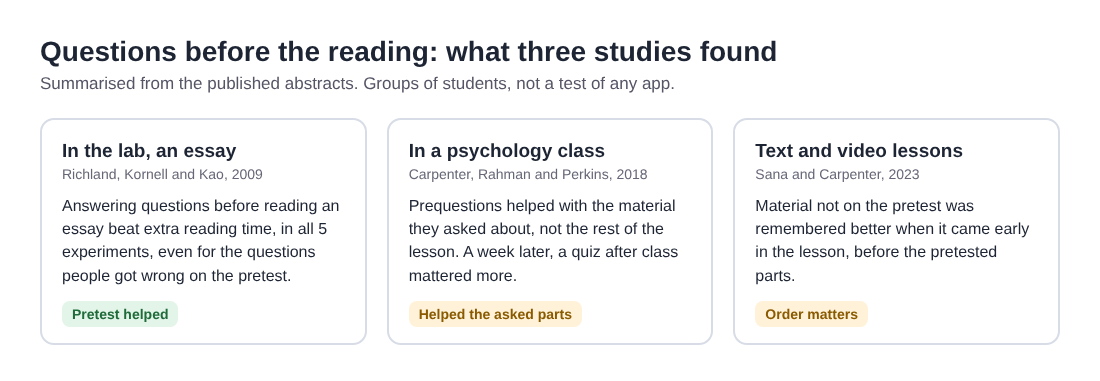
Richland, Kornell and Kao, 2009. In five experiments, people read an essay about vision. One group first answered questions about ideas in the essay, then read it. The other group got extra reading time instead. The tested ideas were marked in bold or italics for both groups, so the pretest was not just pointing at the right sentences. The pretest group did better on the final test in every experiment. The researchers counted only the questions people had missed on the pretest, so the gain came from trying and failing, not from already knowing.
Carpenter, Rahman and Perkins, 2018. This study moved into an introductory psychology course. Students were randomly put into a group that got prequestions before each lesson or a group that did not. At the end of class, the prequestion group remembered more, but only of the material the prequestions asked about. On other parts of the same lesson they did about the same as everyone else. A week later, both groups remembered material that had been quizzed at the end of class better than material never quizzed, and by about the same amount. The authors' reading: students gain from retrieval practice, and prequestions add little, if anything, on top of it.
Sana and Carpenter, 2023. People took a pretest on half of a lesson, then read a text or watched a video lecture. The question was what happens to the half that was not pretested. It was remembered better when it came at the start of the lesson, before the pretested parts, than when it came at the end. The authors note that this broader benefit sometimes shows up and sometimes disappears or reverses.
The catch: a pretest helps most with what it asked
Put the studies together and one rule stands out. A pretest works like a set of flags on the page. The points it flagged are remembered better. The points it did not flag may not be.
That changes how you use one. A five-question pretest on a whole chapter flags five points and leaves the rest alone. A short pretest on each page flags more of the chapter. And because the classroom study found the quiz after class mattered most a week later, the pretest should open your study session, not be all of it.
This is our suggestion built from the studies, not something they tested as a routine: pretest a page, read it, then quiz yourself on the same page later.
A worked example: one biology page, quiz first
Say tonight's reading is a biology page about photosynthesis, and you have not opened it yet.
- Snap the page. In Study Shot, choose Make a new quiz, then Take photo. Hold the page flat and fill the frame.
- Keep it short. Pick 5 questions. The guide to levels and question counts suggests Tiered with 5 or 10 questions for a new topic, which starts with basic questions and climbs. Basic, which sticks to key terms, facts and definitions, also fits a pretest, since those are the points the page states outright.
- Press Create questions and wait while it reads your page.
- Answer without looking. During a quiz, Show page brings up your photo. For a pretest, leave it closed.
A question like the one on Study Shot's home page might come up: "Where in a plant cell does photosynthesis take place?" with four choices, the mitochondria, the chloroplasts, the nucleus and the cell wall. Before you pick, try to say an answer to yourself first, as the guide to answers and explanations suggests. You think of energy and pick the mitochondria. You press Check answer and see Not quite., the correct answer, the chloroplasts, and a short explanation.
One difference from the studies: in Study Shot you see the right answer straight after each guess, while in the lab studies people found it in the reading. Either way, the guess comes first and the answer follows soon after.
At the end, the results list your misses under Look at these again, with Your answer and Right answer. Now read the page. When you reach the sentence about chloroplasts, you already have a question waiting for it.
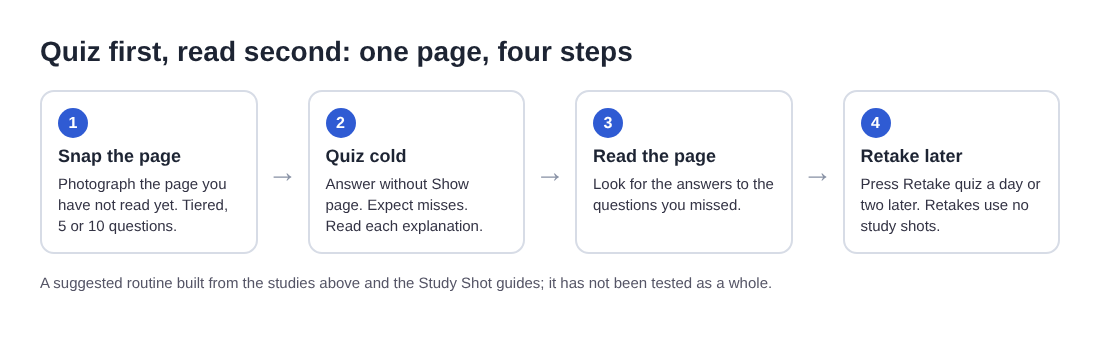
Last, come back to it. Press Retake quiz from your library a day or two later, as the guide to results and retakes suggests. Now the quiz is retrieval practice on a page you have read, the part the classroom study found mattered a week later. Taking a quiz and retaking it use none of your monthly study shots.
How to pretest a whole chapter, page by page
Study Shot writes a quiz from one photo, so a chapter is a set of pages. That fits the research well, since each pretest flags only what it asks.
- Before each page or two, make a short pretest on that page. Guess, read the explanations, then read the page.
- Do not stop at the pretest. Once the chapter is read, retake each page's quiz, or make a new quiz from the same photo at a higher level to check that you can use the ideas, not only name them.
- Spread the retakes out. A retake the next day tells you more than one straight after reading.
The questions are written by an AI model and can contain mistakes. The explanation helps you check against the page, and if a question looks wrong, use Report a problem with this question under it.
Mistakes that waste a pretest
- Treating the score as a grade. A low score is the expected result.
- Peeking at the page. Opening Show page turns the pretest into reading with extra steps.
- Making one long quiz for a long chapter. A quiz comes from one photo, so it flags only that page; pretest the pages one at a time.
- Never quizzing after. In the classroom study, the quiz after the lesson carried the week-later benefit.
Frequently asked questions
Is it bad to guess wrong on a pretest?
No. In Richland, Kornell and Kao's experiments, the gain showed up on questions people had missed on the pretest. What matters is that you see the right answer soon after.
Does a pretest help with the parts of a chapter it did not ask about?
Not reliably. In the classroom study it did not, and Sana and Carpenter found the broader benefit sometimes appears and sometimes does not, depending partly on where that material sits in the lesson.
Is a pretest better than a quiz after reading?
They do different jobs. In the classroom study, a quiz after class carried the benefit a week later, and prequestions added little on top, so use the pretest to start and the later quiz to check.
How many questions should a pretest have?
Keep it short, around 5 for one page. Study Shot's levels guide also notes that a short page does not have 20 good questions in it.
Get started
Next time you open a new chapter, spend a few minutes guessing before you read. Snap the first page, ask for 5 questions, read the explanations, then read the page and come back to the quiz a day or two later. Study Shot runs in the web browser on a phone or a computer, so you can do it wherever your textbook is.
Try Study Shot: it is free to start. Photograph the page you are studying tonight and get practice questions on it, from basic to advanced, with every answer explained.