Does Practice Testing Help You Apply What You Learned?
Practice testing can help you use ideas on new questions, not only repeat answers. What two studies found, where transfer is weak, and a one-page routine.
You can answer every question in the chapter review. Then the test asks you to use the same idea on a case you have never seen, and you freeze. So does practice testing help you apply what you learned, or does it only help you repeat it? Two studies that asked that question directly say it can help, with some limits worth knowing. This post explains what they found, when practice carries over and when it does not, and a routine you can run on one page tonight with Study Shot, which turns a photo of a page into a practice quiz.
Recalling a fact and using it are two different jobs
Say your biology page tells you that photosynthesis happens in the chloroplasts. A recall question asks where photosynthesis takes place. You remember the word, you pick it, done.
A question that asks you to use the idea looks different. It might describe a cell with no chloroplasts and ask what that cell cannot do. The fact is the same. The job is not. You have to take what you know and carry it to a new situation.
Researchers call that carry-over transfer. It is what most of us mean when we say we want to understand something, not only memorise it. And it is the part many students worry practice quizzes skip. If you drill the same questions until you know the answers, have you learned the idea, or only the answers?
Does practice testing help you apply what you learned? What the research says
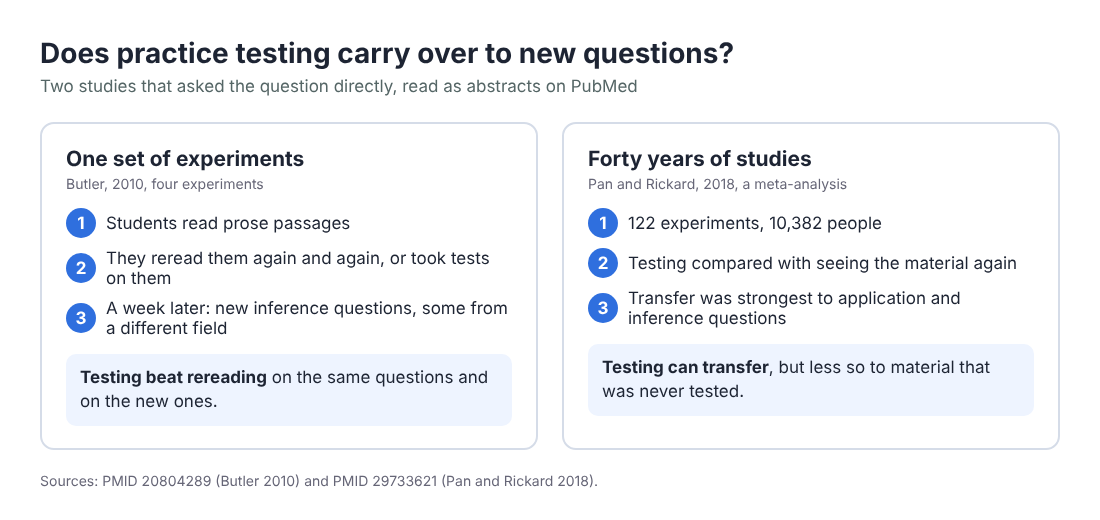
Butler, a psychologist then at Washington University in St. Louis, tested this in four experiments published in 2010. Students read prose passages. Some reread the passages again and again; others took tests on them. A week later, everyone sat a final test. In some experiments it had the same questions. In others it had new inference questions about the same topic, and in one it had new inference questions from a different field.
Repeated testing beat repeated studying on the final test, on the old questions and on the new ones. Butler concluded that the benefit of testing is not limited to the exact answer you practised; it carries over to using the knowledge in a range of new settings.
One set of experiments is a start, not a verdict. So in 2018 Pan and Rickard, at the University of California, San Diego, pulled together the research on exactly this question. Their review covered 192 effect sizes from 122 experiments in 67 published and unpublished articles, with 10,382 people, spanning more than 40 years. Compared with simply seeing the material again, testing could produce learning that transferred to new questions and settings.
Transfer was greatest to a different test format, to application and inference questions, and to problems involving medical diagnoses. That is good news if your exam asks you to use ideas rather than repeat them.
Three kinds of question about the same page
It helps to see what an application question looks like next to the others. Here are three questions about one photosynthesis page. I wrote them as examples; they are not output from any app.
- Recall: Where in a plant cell does photosynthesis take place? You know "the chloroplasts" or you do not.
- Explain or connect: Why do the cells in a leaf have many chloroplasts while root cells have almost none? Now you link a part of the cell to its job.
- Apply or predict: A plant is left in a dark cupboard for a week. Can it keep making sugar, and why? The page never mentioned a cupboard. You have to use the idea.
Study Shot's levels follow the same ladder. Basic questions check key terms, facts and definitions. Intermediate questions ask you to explain, compare and connect ideas. Advanced questions ask you to apply and predict in new situations, using what the page teaches.
When practice testing transfers less
The same review is honest about the limits, and they matter for how you study.
- Material you never tested. Transfer was weakest to material that people saw while studying but were not tested on. So a quiz on page 40 is a weak way to learn page 41.
- Questions that only shuffle the pieces. Transfer was also weak when the same items came back rearranged, and for problems built on worked examples.
- Practice done without three ingredients. Pan and Rickard found that three things strongly shaped whether transfer happened: how closely the answers in practice matched what the final test asked for, whether the practice made people retrieve in a fuller, more elaborate way, and how well people did on the practice test in the first place. When they corrected for possible publication bias, the predicted transfer often dropped to none when those factors were missing.
Put plainly: testing yourself is not magic. It helps you use ideas when the practice asks you to use them, when you get enough of it right to learn from, and when it covers the material the test will cover.
How to practise for questions you have not seen yet
Here is how those findings turn into habits. These are suggestions drawn from the two studies, not rules from them.
- Quiz every page you will be tested on. Untested material transferred least, so do not skip the pages that look easy.
- Include questions that ask you to use the idea. Transfer was strongest to application and inference questions, so practise some of those, not only definitions.
- Get the basics right first. How well people did on the practice test shaped transfer. If you miss most of the hard questions, go back a level, then climb.
- Read why, not only what. After each answer, read the explanation and say the reason in your own words. Saying why asks you to recall more than a letter.
- Come back after a break. Butler's final tests were a week later. A retake a day or two later shows what has stuck.
A worked example with one biology page
Take a page on photosynthesis from your biology textbook. Here is the routine with Study Shot, step by step.
- Snap the page. Press Make a new quiz, then Take photo or Choose photo. Hold the page flat and fill the frame.
- Pick Tiered and 10 questions. Tiered is a ladder: basic first, up to advanced. With 10 questions the line under the numbers says about 3 basic, 4 intermediate and 3 advanced. Press Create questions; it can take up to a minute.
- Answer and read every explanation. Pick an option, press Check answer, and read the explanation, whether you were right or not.
- Read the level scores. Your results show a score for each level. Say you got 3 of 3 basic and 1 of 3 advanced. The results guide puts it simply: if the advanced score is low and the basic score is high, you know the facts but not yet how to use them.
- Make a new quiz on the same photo with Advanced picked. Advanced questions ask you to apply and predict in new situations, using what the page teaches. The levels guide suggests exactly this when a quiz feels too easy.
- Retake a day or two later. Open the quiz from your library and press Retake quiz. Getting it right after a break is a much better sign that you have learned it.
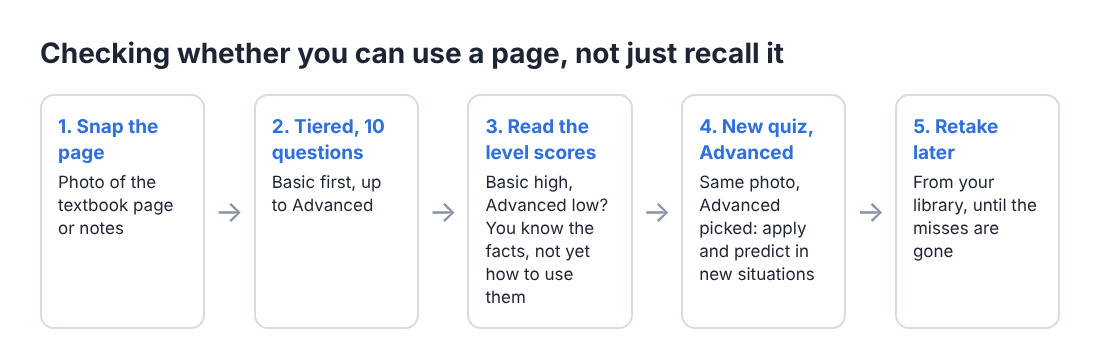
Taking and retaking a quiz uses no credits; only making a new one does. The levels guide explains each level, and the results guide shows how to read the level scores.
What a practice quiz can and cannot do here
Every Study Shot question is multiple choice, with four options and one right answer. The research above found transfer across test formats, so practising in one format can still help on another. Still, if your exam has written answers, also try explaining the idea on paper without the choices in front of you.
The questions are written by an AI model and can contain mistakes. The explanation after each answer helps you check, and you can use Report a problem with this question if one looks wrong.
And a quiz covers the page you photographed. For a chapter, go a page at a time, as in how to study a whole chapter one page at a time. For more on why testing yourself works at all, see the testing effect explained for students.
Frequently asked questions
Does practice testing only help you memorise answers?
No. Butler's 2010 experiments and the Pan and Rickard review both found that testing can help on new questions, including application and inference questions. The help was weakest for material that was never tested.
What is transfer of learning?
Transfer is using what you learned in a new situation, such as a question you have not seen or a problem in a different setting. It is the opposite of only repeating an answer you practised.
Which Study Shot level asks you to apply what you learned?
Advanced. Its questions ask you to apply and predict in new situations, using what the page teaches. Tiered includes some Advanced questions at the end of its ladder.
How soon should I retake a quiz?
The results guide suggests a day or two later, not just straight away. Getting it right after a break is a much better sign that you have learned it.
Get started
Try Study Shot: it is free to start. Photograph the page you are studying, take a Tiered quiz, and see whether your Advanced score matches your Basic one.