The Testing Effect Explained for Students
What the testing effect is, what a 2006 study found, and how to turn it into a simple study routine that uses practice quizzes made from your own notes.
The testing effect explained for students comes down to one idea: pulling information out of your memory helps you remember it better than putting the same information in again. Quizzing yourself is not just a way to check what you know. It is one of the most useful ways to learn it in the first place.
This post covers what the effect is, why it works, how to build it into your week, and where students go wrong. You will also see a worked example of turning a page of notes into practice questions.
The testing effect explained for students
The testing effect is the finding that trying to recall something strengthens your memory of it more than studying it again. The word "testing" can mislead you. It does not mean a graded exam. It means any moment where you try to bring an answer to mind without looking at it.
Here are a few everyday examples:
- Covering your notes and writing down what you remember.
- Answering a question at the end of a textbook chapter.
- Explaining a topic out loud to an empty room.
- Taking a short multiple-choice quiz on a page you read yesterday.
All of these ask your brain to do the work of finding the answer. That effort is the point.
Why testing yourself beats rereading
Rereading feels productive. The page looks familiar, the words flow, and you think, "I know this." But recognising a sentence while it is in front of you is much easier than producing it from nothing. On exam day, nothing is in front of you.
Retrieval practice gives you two things that rereading does not:
- An honest signal. If you cannot answer a question, you know exactly what to study next. Rereading hides gaps behind a feeling of familiarity.
- Practice for the real task. Exams ask you to recall and apply. Quizzing rehearses exactly that.
Quizzing often feels harder than rereading. That is normal, and it is not a sign the method is failing.
What the research says about retrieval practice
The best-known study of the effect used school-style material. In 2006, Henry Roediger and Jeffrey Karpicke published two experiments in the journal Psychological Science. Students studied prose passages. Some then took one or three recall tests without feedback. Others restudied the passage the same number of times. The students were then tested again 5 minutes, 2 days or 1 week later. You can read the abstract on PubMed.
The result depended on the delay:
- After 5 minutes, repeated studying gave better recall than repeated testing.
- After 2 days or 1 week, prior testing produced substantially greater retention than studying.
- Confidence went the other way. Repeated studying made students more confident that they would remember, even though testing gave them better retention.
The authors concluded that testing is a powerful means of improving learning, not just assessing it. For a student, the lesson is plain: rereading can make you feel ready tonight, while quizzing is what helps on the day of the test.
This is one study, and it tested free recall of prose, not multiple-choice questions. Treat it as the clearest reason to try retrieval practice, not as a promise about any one quiz.
How to use the testing effect in your study routine
You do not need to rebuild your whole routine. Add retrieval at a few fixed points.
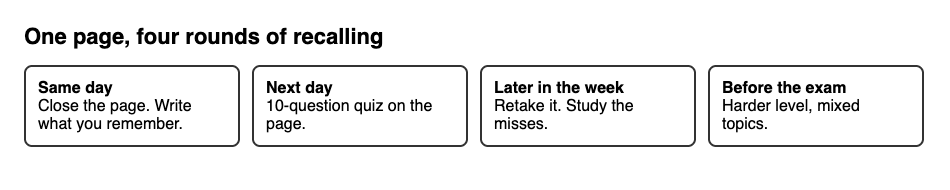
- Same day. After a class or a reading session, close the book and write down or say what you can remember. Then check.
- Next day. Take a short quiz on yesterday's page. Ten questions is plenty.
- Later in the week. Retake the quiz or try a harder version. Focus on the questions you missed.
- Before the exam. Do mixed practice across several topics, at a harder level.
A worked example: you have a biology page on photosynthesis. On Monday you read it once. On Monday evening you take a 10-question quiz. You miss two questions about where each stage happens. On Tuesday you read only the part about those two points, then retake the quiz. By Friday you try an advanced version that asks you to predict what happens in a new situation. You have used the page three times, and each time you were recalling, not rereading.
Best types of practice questions to use
Different question types train different skills. Match them to where you are in your studying.
Key terms and definitions
Use these early. They check that you know the basic vocabulary and facts, which everything else depends on.
Explain and compare
Use these once the basics are solid. Questions that ask you to explain why something happens, or how two ideas differ, force you to connect what you know.
Apply and predict
Use these closest to the exam. They put you in a new situation and ask what would happen. This is the hardest level, and it is where understanding gets tested rather than memory alone.
Multiple-choice questions are good for fast, frequent practice. Writing your own short answers is slower but can show you more about what you really know. A mix works well.
Common mistakes that weaken the testing effect
- Peeking too soon. If you check the answer before making a real attempt, you lose most of the benefit. Commit to an answer first.
- Skipping the explanation. Getting a question wrong and moving on wastes the best learning moment. Read why the right answer is right.
- Only quizzing what you already know. It feels good to score well, but the missed questions are where the learning is.
- One big session. Spreading your quizzes across several days gives you a check on what you still remember after a gap, which a single night cannot.
- Never going harder. If every quiz is basic, you may feel ready and still struggle with application questions.
Turn your notes into quizzes with AI
The hard part of retrieval practice is usually making the questions. Writing good ones takes time, and that time is easy to skip. Study Shot removes that step. You photograph a page from a book, your notes or a whiteboard, and an AI model writes multiple-choice questions about it. It runs in your web browser on a phone or a computer.
Here is how it maps to the routine above:
- Pick the number of questions. Choose 5, 10, 15 or 20. The default is 10.
- Pick a level. Basic covers key terms, facts and definitions. Intermediate asks you to explain, compare and connect ideas. Advanced asks you to apply and predict in new situations. The default, Tiered, climbs from basic to advanced in one quiz.
- Answer, then check. You pick an option and press Check answer. You see whether you were right, the correct answer, and a short explanation.
- Review what you missed. The results screen lists the questions you got wrong with your answer and the right answer, so you know what to restudy.
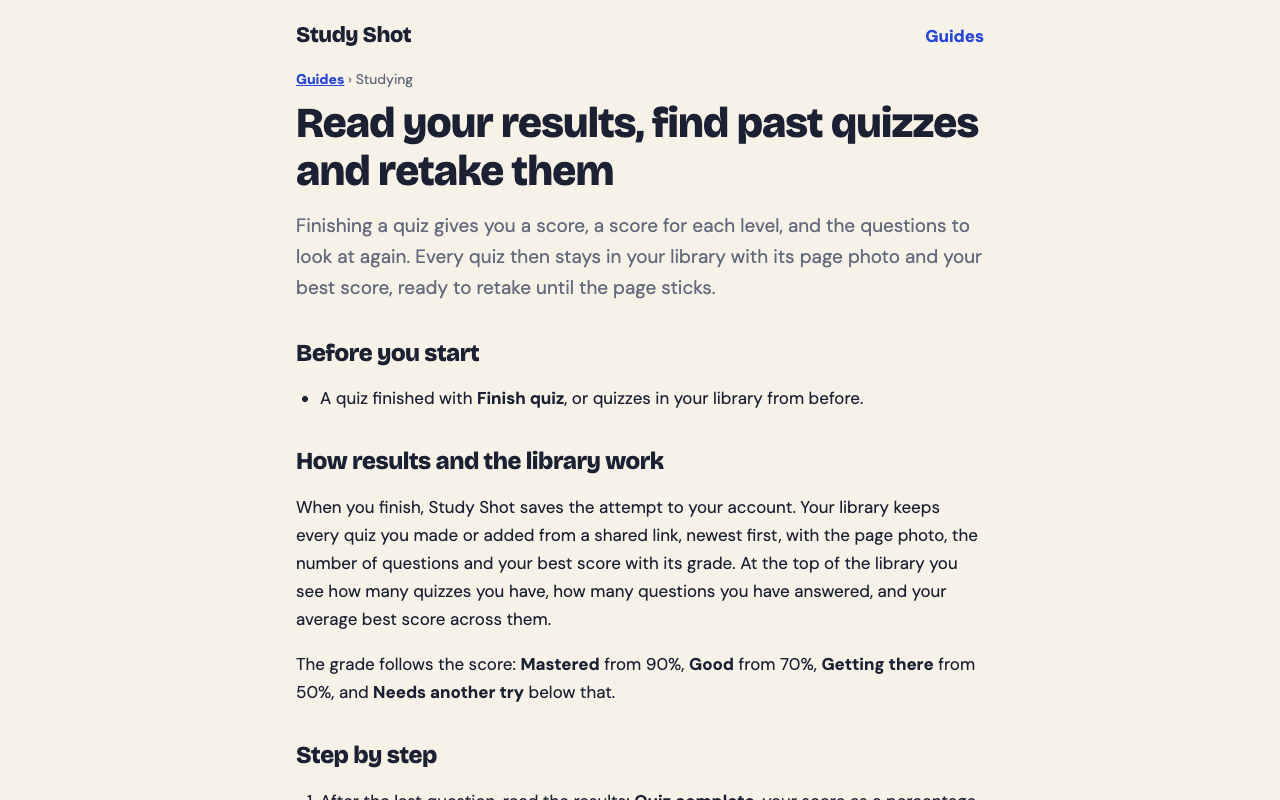
- Retake later. Quizzes are saved in your library with your best score. Retaking a quiz uses no credits, which suits the routine above.
The AI can make mistakes, so treat the explanations as a way to check your thinking against your page. If a question looks wrong, you can use Report a problem with this question.
For a step-by-step walkthrough, see how to make your first quiz. A clear photo gives better questions, and the guide on taking a good photo of a page shows how. To match difficulty to your stage of studying, read about choosing a level and number of questions. If you want the phone workflow, there is a post on making a practice quiz from a photo on your phone, and another on whether AI can make a quiz from a photo of your notes. For using misses well, see answering and learning from explanations.
Frequently asked questions
What is the testing effect in simple terms?
It is the finding that trying to recall information can help you remember it longer than studying it again. In the 2006 study above, the gap showed up on tests given 2 days and 1 week later.
Do I need to take real exams to get the benefit?
No. Low-stakes practice such as flashcards, self-written questions or short quizzes can be used the same way. What matters is that you attempt an answer before you look at it.
How often should I quiz myself?
There is no single rule. A pattern that fits the routine above is the same day, the next day, and again a few days later, then a harder round before the exam.
Does Study Shot charge for retaking a quiz?
No. Taking a quiz, retaking it, and taking a quiz someone shared with you use no credits. Writing a new quiz does use credits from your monthly allowance.
Can I get quizzes in my own language?
Yes. You can choose from 50 languages for the questions, answers and explanations. The app's own screens stay in English.
Get started
Try Study Shot: it is free to start. Photograph the page you are studying tonight and get practice questions on it, from basic to advanced, with every answer explained.