Does Practice Testing Work for Adults Going Back to School?
Most quiz research uses college freshmen. What two studies of adults up to 65 found about practice testing, and a one-page week plan for a returning student.
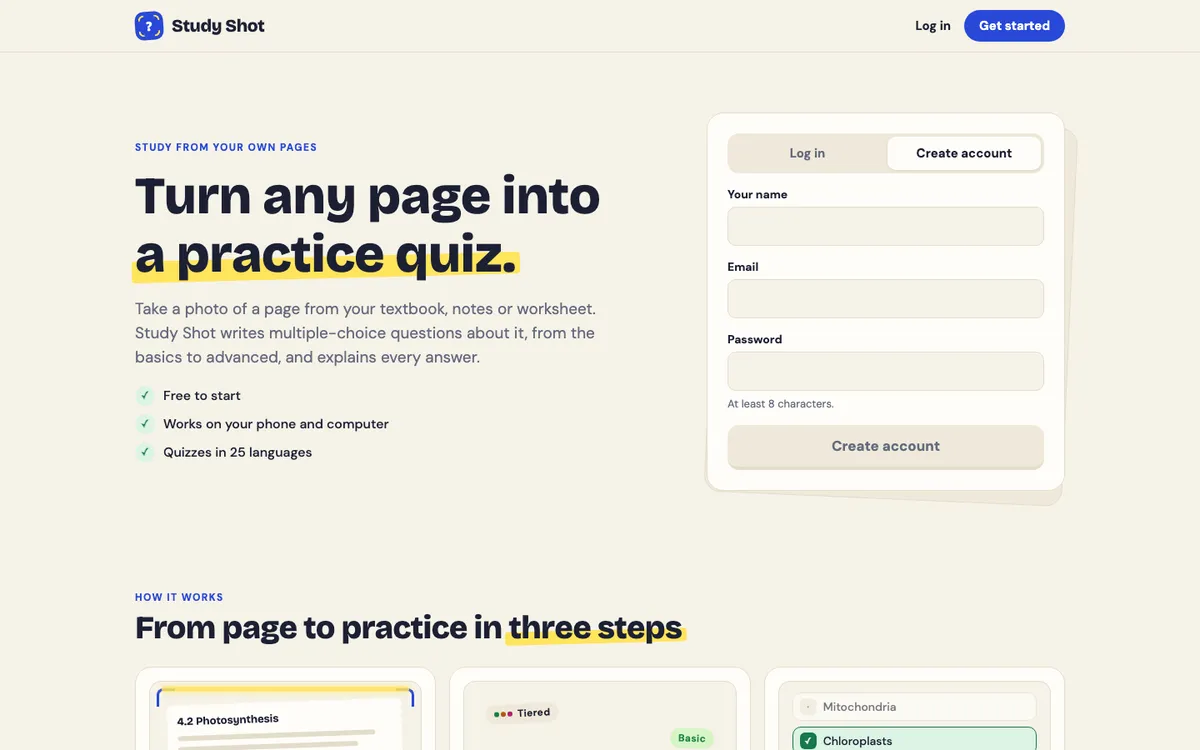
You are back in a classroom after ten or twenty years, with a job, a family and a reading list. Every study tip you find seems written for a 19-year-old in a dorm. So does practice testing work for adults going back to school, or only for the college freshmen most studies use? Two studies that looked past the freshman give a fair answer, and this post walks through them, what they leave open, and a plan for one page a week. If you want to try it while you read, Study Shot turns a photo of a page into a practice quiz, with every answer checked and explained.
Why the question is fair to ask
Practice testing means answering questions about what you studied, instead of reading it again. The research on it, often called the testing effect, is summed up for students in the testing effect explained for students.
The catch for a returning student is who took part. Much of that work was done with university students, and the first study below says so in its own title: it argues the method should be checked with learners of other ages, outside the usual university setting. A 45-year-old night student is a different reader: older, out of practice at exams, studying in short gaps. It is reasonable to ask whether the same method helps you before you build your week around it.
Does practice testing work for adults going back to school? Two studies
The first study is by Meyer and Logan at Rice University, published in Psychology and Aging in 2013. Its title says what it set out to do: take the testing effect beyond the college freshman. It compared three groups of 60 people each:
- university students aged 18 to 25,
- adults from the community aged 18 to 25 who were not university students,
- adults from the community aged 55 to 65.
Each group was checked right away and again two days later. All three groups gained from testing, and by about the same amount, at both delays. The authors conclude that testing can be a useful tool for lifelong learning, for many kinds of learners, not only for students already in a university.
The second study, by Maddox and Balota in Memory and Cognition in 2015, compared young and older adults who took one, three or five tests on what they learned. It asked a different question: does it matter how the tests are spread out? Two results matter for you:
- Repeated tests with time between them (spaced) helped more than a single spaced test, for both the young and the older adults.
- Repeated tests back to back (massed) helped more than a single test only for the young adults.
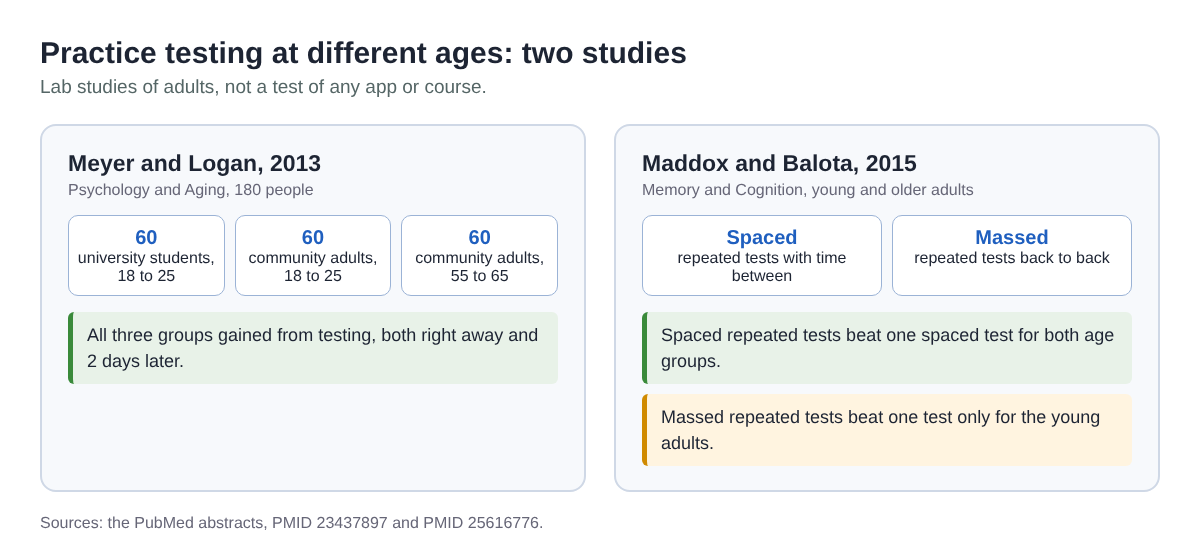
Put together, the first study says the benefit of testing does not belong only to young students. The second adds a practical rule for an older learner: space your retakes out, because for the older group, tests taken back to back did no better than a single test.
What these studies do not show
Both are lab studies, read here from their published summaries. They report results for groups, not a promise for one person. Neither tested a course, a certification exam or any app, Study Shot included. The oldest group in Meyer and Logan was 55 to 65, so the study says nothing directly about people older than that, and its longest delay was two days, not a term.
So the honest answer to the title is: the evidence that exists points the same way for adults as for younger students, and it suggests spacing matters at least as much when you are older. It does not prove that any one routine will raise your grade.
Practice testing may also help you use an idea on a new kind of question, not only repeat a fact. That evidence is covered in does practice testing help you apply what you learned.
Fitting practice testing around work and family
None of the studies tell you how to fit testing into a week with a shift, a commute and children. These are suggestions, built on what the app does:
- Work one page at a time. A quiz covers the page you photograph. One page, or one page of notes from tonight's class, is a size you can finish in a lunch break.
- Keep first quizzes short. The levels guide says that for a short page, 5 or 10 questions is usually the better quiz, and that more questions cost more credits.
- Space the retakes. This is the part the Maddox and Balota study backs. The results guide says the same: retake a quiz a day or two later, not just straight away.
- Use whichever screen is near you. Study Shot runs in the web browser on a phone or a computer, so a quiz made on a laptop at home can be retaken on a phone on the bus.
Retakes are cheap in another way too. Taking and retaking a quiz uses no credits; only writing a new quiz does.
A worked example: one page, three short visits
Say you are in an evening course and this week's reading has a page on blood pressure. Here is one way to work it, start to finish.
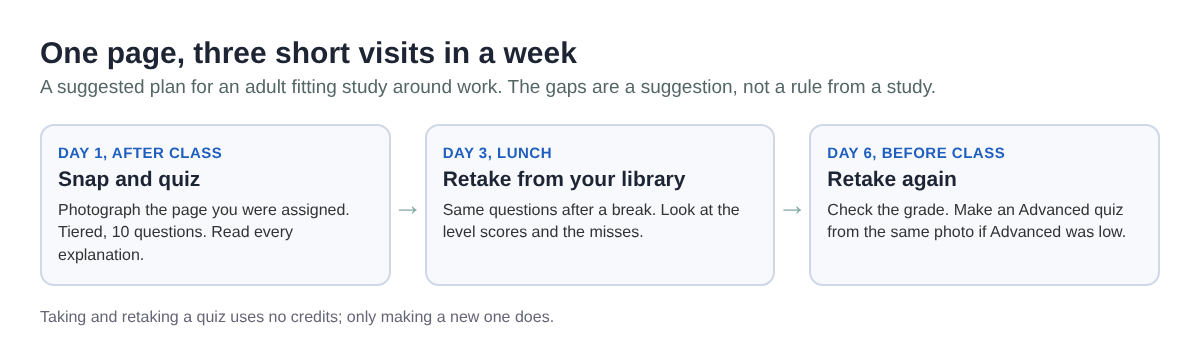
- Day 1, after class. In Study Shot, choose Make a new quiz, then Take photo or Choose photo. Hold the page flat and fill the frame. Leave the level on Tiered, the default ladder from basic to advanced, pick 10 questions and press Create questions.
- Answer one question at a time. Each has four choices. Press Check answer, and you see Correct! or Not quite., the right answer and an explanation. The explanations guide suggests saying the answer to yourself before you read the four options. If a detail slips, Show page brings your photo back.
- Read the results. You get a percentage, a grade and a score for each level. Scroll to Look at these again, which lists each miss with Your answer and Right answer.
- Day 3, lunch. Open the quiz from your library and press Retake quiz. Same questions, after a break.
- Day 6, before class. Retake it once more. If your Basic score is high and your Advanced score is low, make a new Advanced quiz from the same photo.
A Tiered quiz on that page would likely start with what the terms mean, move to how the ideas compare, and end with questions that ask you to use the page on a new case, since that is how the levels are described: Basic checks key terms, facts and definitions, Intermediate asks you to explain, compare and connect ideas, and Advanced asks you to apply and predict in new situations. The exact questions depend on what is on your page.
The results guide puts the level scores plainly: if the advanced score is low and the basic score is high, you know the facts but not yet how to use them. The grade tells you when to stop. Mastered starts at 90%, Good at 70%, Getting there at 50%, and below that is Needs another try. A page that reaches Mastered after a break can wait; a page stuck at Getting there gets another visit.
What a practice quiz can and cannot do for you
The questions are written by an AI model and can contain mistakes. The explanation after each answer helps you check, and if a question looks wrong, choose Report a problem with this question. Your textbook and your instructor are still the final word.
Every question is multiple choice with four options, so it checks whether you can pick the right answer, not whether you can write an essay or work a long problem by hand. And a quiz covers the page you photographed, so a chapter takes several photos.
If English is not your first language, the questions, answers and explanations can come in 50 languages, while the app's own screens stay in English. If your exam is in English, practise in English too.
Frequently asked questions
Does practice testing still work if I am over 40?
In Meyer and Logan's 2013 study, adults aged 55 to 65 gained from testing about as much as university students did, both right away and two days later. That is a lab result for groups, not a guarantee for one person.
Should older learners space out their practice tests?
Maddox and Balota found that repeated tests with time between them helped both young and older adults, while back-to-back tests added benefit only for the young adults. Retaking a quiz a day or two later fits that.
How long does one practice quiz take?
It depends on you and the page. You choose 5, 10, 15 or 20 questions, and the levels guide suggests 5 or 10 for a short page.
Can I trust the questions Study Shot writes?
Not blindly. They are written by an AI model and can contain mistakes, so read each explanation against your page and use Report a problem when one looks wrong.
Get started
Pick one page from this week's reading, make a short Tiered quiz, and put two retakes in your calendar a few days apart. If you are new to the app, make your first quiz walks through each step.
Try Study Shot: it is free to start. Photograph the page you are studying tonight and get practice questions on it, from basic to advanced, with every answer explained.