Does Saying the Answer Out Loud Help You Remember It?
Reading some words aloud helps them stick, but when you quiz yourself, thinking of the answer worked as well as saying it. What three studies found, and how to use both.
Saying the answer out loud can help you remember it, but less than you might think, and not for the reason most people assume. Reading some words aloud while you study makes them easier to remember than words you read silently. But when you quiz yourself, one study found that thinking of the answer in your head helped later memory just as much as actually giving it. This post walks through three studies, then shows how to use your voice well in a practice quiz from Study Shot, which turns a photo of a page into multiple-choice questions.
Saying the answer out loud: the short answer
There are two different habits hiding in this question, and the research treats them separately.
- Reading aloud while you study. You say some words or facts from the page out loud as you read. Psychologists call the memory boost from this the production effect.
- Answering aloud when you test yourself. You see a question, pull the answer from memory, and say it. This is retrieval practice, and the act of recalling is the part that does the work.
For the first habit, speaking helps, as long as you do not speak everything. For the second, the study below found that recalling the answer mattered, and whether you said it or thought it did not.
What the production effect studies found
In 2010, MacLeod and four colleagues at the University of Waterloo published eight experiments on this. People studied lists of words, read some aloud and some silently, and were later asked which words they had seen. Words said aloud were remembered better.
The catch was in how the lists were set up. The effect was limited to mixed lists, where only some of the words were spoken. The authors' explanation is distinctiveness: saying a word adds extra information to your memory of it, which helps you tell it apart from the others later. If every word gets the same treatment, nothing stands out.
Two other results from the same paper are useful. Mouthing a word without making a sound still gave a benefit. And the effect was not explained by students reading the silent words lazily, which the researchers checked directly.
Why hearing your own voice adds to it
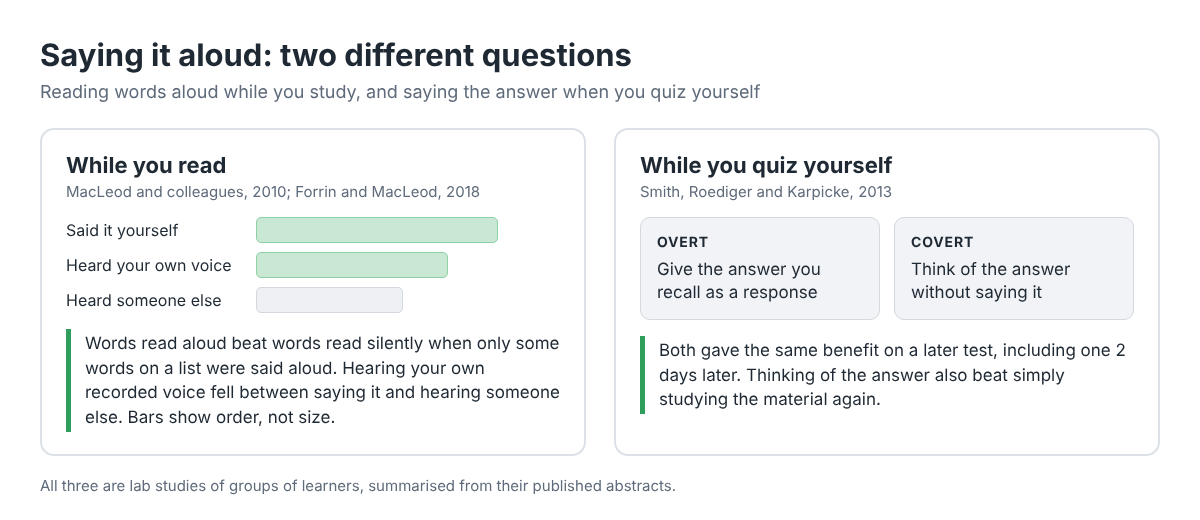
In 2018, Forrin and MacLeod asked which part of speaking matters: moving your mouth, or hearing yourself. People studied words in four ways. They read some aloud, heard a recording of themselves reading others aloud, heard someone else read some, and read the rest silently.
Memory followed a ladder. Saying the word yourself came out on top, and hearing your own recorded voice landed between saying it and hearing another person say it. The authors conclude that speaking helps for two reasons: the act of speaking itself, and the fact that the voice you hear is your own.
For a student, that suggests your own voice is worth more than a recording of someone else reading your notes to you. Keep in mind that these were lab studies with word lists, not tests of whole chapters.
Out loud or in your head when you quiz yourself
Here is where it gets interesting for anyone who studies with practice questions. In 2013, Smith, Roediger and Karpicke at Washington University in St. Louis ran four experiments. People took a first test, either giving their answers as responses (overt) or only thinking of them without producing them (covert), and then took a second test later.
Thinking of the answer helped as much as giving it, including when the later test came two days afterwards. In the fourth experiment, thinking of the answer also beat simply studying the material again. The authors wrote that this goes against the idea that giving an overt response is better, and that students can learn as much from testing themselves silently. Saying an answer out loud is one way of giving it, which is why this study speaks to the question in this post.
Put that next to the production effect and you get a clear rule. When you quiz yourself, the effort of recall is what counts. Saying your answer aloud is fine, and it can keep you honest, but a silent, real attempt is not a weaker version. The one thing that does not count is skipping the attempt and going straight to the options.
How to use your voice in a practice quiz
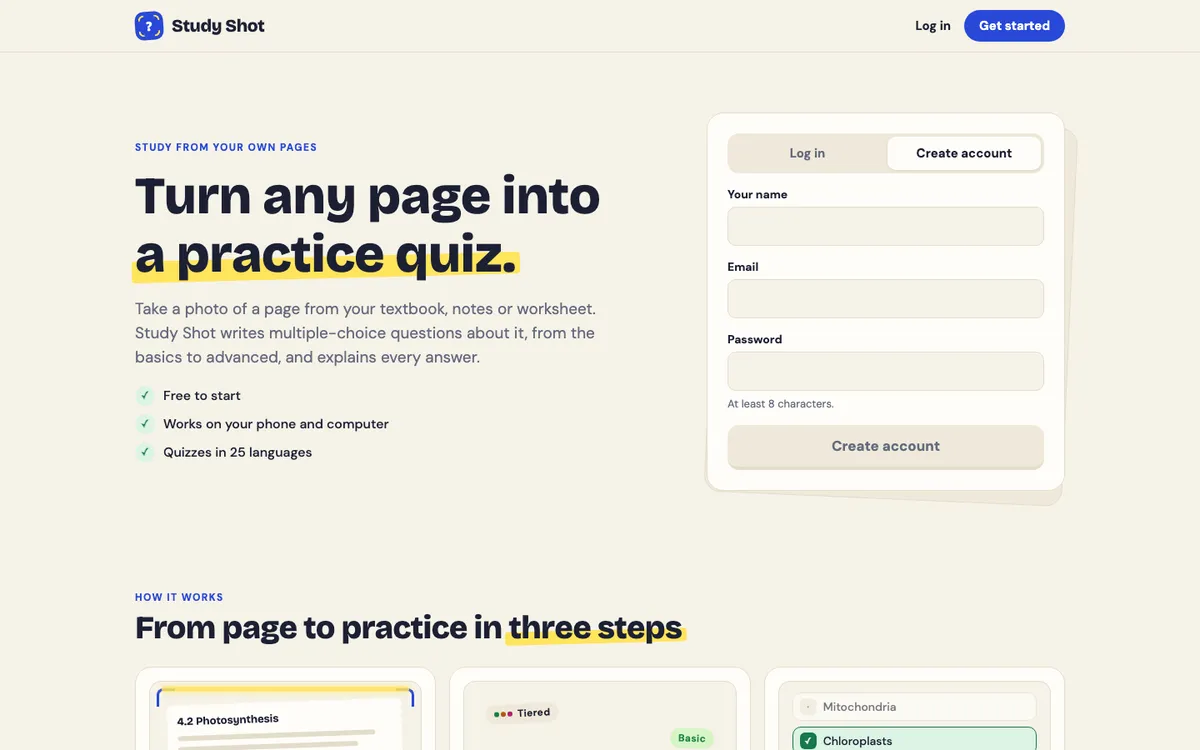
Here is a worked example with the sample question on the Study Shot home page, which comes from a textbook page about photosynthesis. You can try it there without an account; nothing you tap is saved.
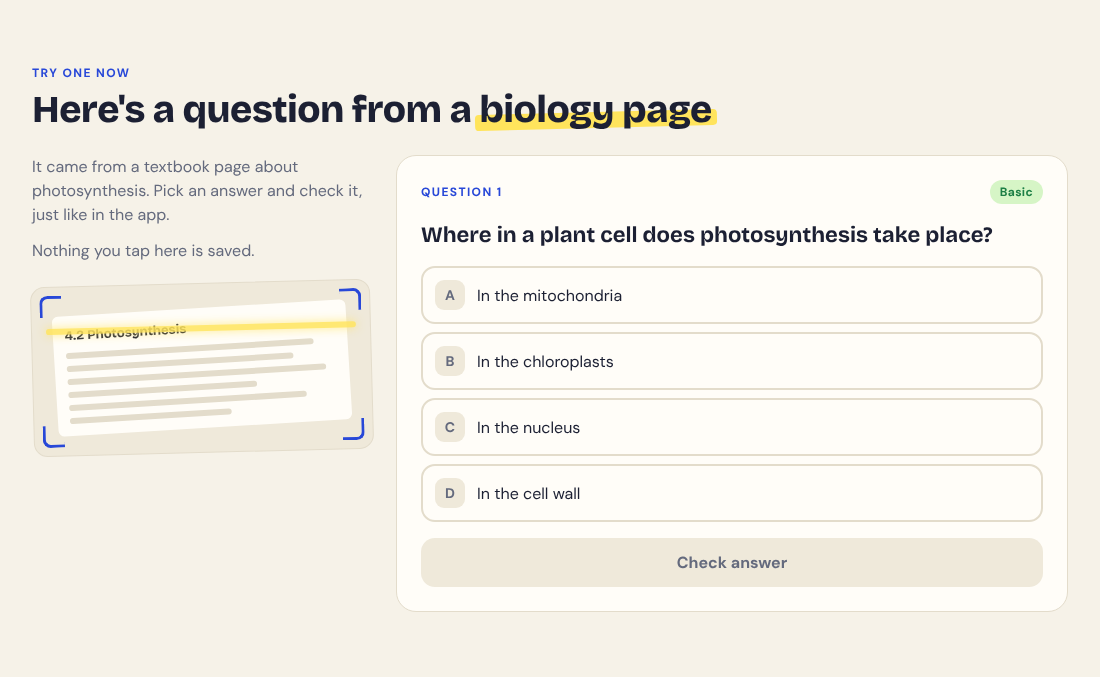
- Read the question, not the options. "Where in a plant cell does photosynthesis take place?" Before your eyes reach A to D, answer it. Say it out loud or in your head; in Smith and colleagues' study, answering in your head worked as well as giving the answer. The guide on answering questions and learning from the explanations gives the same advice: try to say the answer to yourself first, then pick the option that matches.
- Pick the option that matches what you recalled. If you said "chloroplasts", choose B. If you could not recall anything, say "I don't know" and then choose. That tells you something real about what you know.
- Press Check answer and read the explanation. You see Correct! or Not quite., the correct answer, and a short explanation. The questions are written by an AI model and can contain mistakes, so if one looks wrong, use Show page to look at your photo and Report a problem with this question to flag it.
- Say the corrections aloud, and only those. This is where the production effect fits. When you miss a question, read the right answer out loud once. Leave the ones you got right silent. That is a suggestion built from the mixed-list finding: spoken items stand out when not everything is spoken.
- Go through Look at these again at the end. The results screen lists each question you missed with your answer and the right one. Say each right answer aloud as you read it.
- Retake the quiz another day. Every quiz is saved in your library with its page photo and your best score, and retaking it uses none of your monthly study shots. The guide to results, your library and retakes shows where to find it.
To make a quiz from your own page, photograph it, leave the level on Tiered (a ladder from basic up to advanced) and keep the default of 10 questions. For more on why recalling beats looking again, see how to tell if you really know a chapter or only recognise it.
Mistakes to avoid when you study out loud
Reading the whole page aloud
It feels active, but it removes the contrast that made spoken words stand out in MacLeod's experiments, and you still have not recalled anything. Save your voice for the few things you keep missing.
Saying the answer after you peek
If you glance at the four options, spot the right one and then say it, you have recognised it, not recalled it. Answer first, then look.
Thinking silent answers do not count
If you study in a library or on a bus, you do not need to speak. Smith and colleagues found that a real attempt in your head helped as much as giving the answer. The attempt has to be real, though: an actual answer, not a vague sense that you know it.
Frequently asked questions
Is reading my notes out loud a good way to study?
Reading some words aloud helped memory in the production effect studies, but only when not everything was spoken. Reading notes aloud is still rereading, so pair it with questions you answer before you check.
Does mouthing the answer work if I cannot speak?
In MacLeod and colleagues' experiments, mouthing words without sound still helped compared with silent reading. When you are quizzing yourself, a silent answer in your head worked as well as giving the answer in Smith and colleagues' study.
Does this help with learning words in a new language?
The production effect studies used word lists, so they are close. For studies on new-language words specifically, see does quizzing yourself help you learn vocabulary in a new language.
Do these studies prove it works for every student?
No. All three are lab studies of groups of learners working with word lists or short material. They show what tended to happen in those experiments, not what will happen for every person or subject.
Get started
Pick one page you need to know this week. Make a quiz from it, answer each question before you read the options, out loud or in your head, and say only the corrections aloud. Retake it in a couple of days and see which answers come back on their own.
Try Study Shot: it is free to start. Photograph the page you are studying tonight and get practice questions on it, from basic to advanced, with every answer explained.