How to Tell If You Really Know a Chapter or Only Recognise It
Rereading makes a chapter feel familiar, not known. Five closed-book checks, what two studies found, and a one-page routine to see where recognition ends.
You read the chapter twice. Every page looks familiar. Then a test question asks you to use one of those ideas in a slightly new way, and nothing comes. If you want to know how to tell if you really know a chapter, the short answer is this: close the book and try to produce the answer yourself. This post gives you five quick checks, what two studies found about the feeling of knowing, and a routine you can run tonight. Most of the checks need only a blank sheet of paper. For the last step, you can use Study Shot, which turns a photo of a page into a practice quiz.
Why recognising a chapter feels like knowing it
Each time you reread a page, it gets easier to read. The words flow. The diagram looks friendly. It is tempting to take that ease as a sign that you have learned the material.
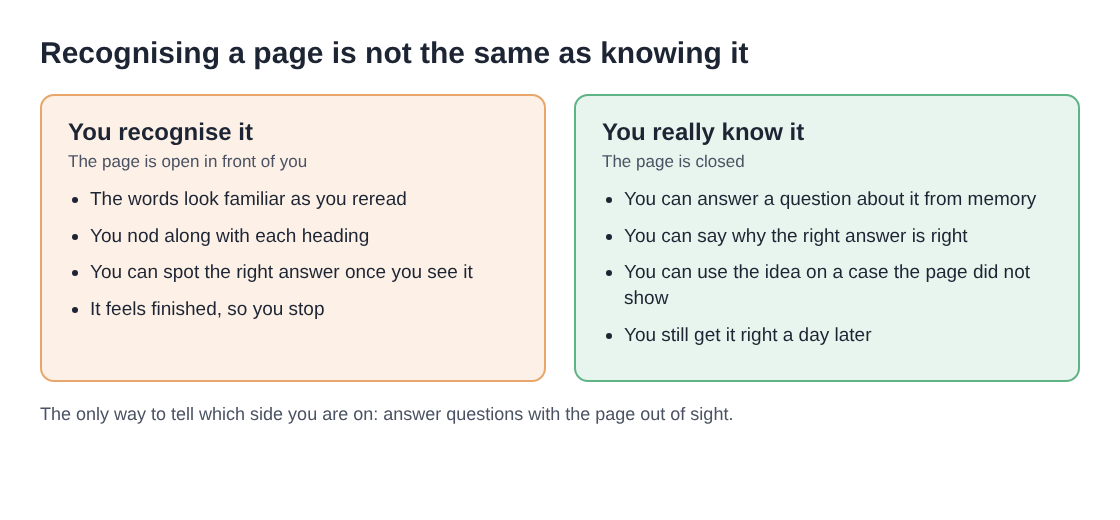
But when the page is in front of you, it does a lot of the work. The headings tell you what comes next. The bold words remind you which terms matter. The diagram holds the structure so you don't have to.
On test day, all of those cues are gone. You get a question and four choices, or a blank space. That is why "I studied this" and "I can answer this" can feel the same the night before and turn out very different the next morning.
Recognition, recall and application
There are three ways of knowing something, and they get harder as you go up.
- Recognition. You see the idea and know you have seen it before. "Chloroplasts, yes, that rings a bell."
- Recall. You can pull the idea out with nothing in front of you. "Photosynthesis happens in the chloroplasts."
- Application. You can use the idea in a case the book never showed you. "A plant kept in the dark makes less sugar, because its chloroplasts have no light to work with."
Rereading keeps you at the first level, because the page is always there to remind you. Test questions ask for the second and the third. The only way to find out which level you have reached is to take the page away.
What studies found about the feeling of knowing
Two studies in the journal Memory looked at how learners judge their own studying.
Karpicke, Butler and Roediger surveyed 177 college students about how they study. A majority said they repeatedly read their notes or textbook, and relatively few tested themselves. The authors propose that many students experience illusions of competence while studying, and that these illusions shape which study strategies they choose.
Kornell and Son ran a flashcard-style experiment with pairs of words. On a second pass, people either saw the whole pair again or saw the first word and tried to recall the second. Participants judged, wrongly, that seeing the pair again taught them more. Yet when they could choose, they picked the recall mode most often, and a questionnaire suggested they did it to find out what they knew, not to learn more.
That second finding is the point of this post. Testing yourself is a way to diagnose what you know. Your own sense of "I've got this" is not a reliable gauge on its own.
Five checks: how to tell if you really know a chapter
Run these with the book closed. Each one is short, and you can do them in any order.
1. The blank page check
Write the chapter's main headings from memory. Under each one, write everything you can. Then open the book and compare. Whatever you missed is material you only recognise.
2. The two-minute explanation
Explain one section out loud, as if to a friend who missed class. Set a timer for two minutes. If you stall or need to glance at the page, you have found a weak spot.
3. Cover the diagram
Pick the most important diagram in the chapter. Cover it and redraw it with labels. Then check. A diagram is easy to recognise and much harder to rebuild.
4. Change one detail
Take a fact and ask "what if?" What if the temperature doubled? What if the reaction ran without a catalyst? If you can predict the result and say why, you understand it. If you can only repeat the book's words, you have memorised it without using it.
5. A quiz you cannot peek at
Answer questions about the page without looking at it, and commit to each answer before you check it. Then look at where your score drops. Doing well on definitions and poorly on "apply" questions means you have recall but not application yet.
Warning signs you only recognise the material
- You see the answer and think "oh, I knew that," but you could not have said it first.
- You can define a term but cannot give an example of it.
- You only know the ideas in the order the book presents them.
- Your answers get much worse as the questions get harder.
- You feel a strong urge to look back at the page before you answer.
None of this means you studied badly. It means you have reached recognition, and the next step is recall.
A worked example: one page of a biology chapter
A whole chapter is too big to check honestly in one sitting. A single page is not. There is more on this approach in how to study a whole chapter one page at a time. Say you are studying a biology page on photosynthesis.
- Read the page once, carefully, then close the book and write what you remember.
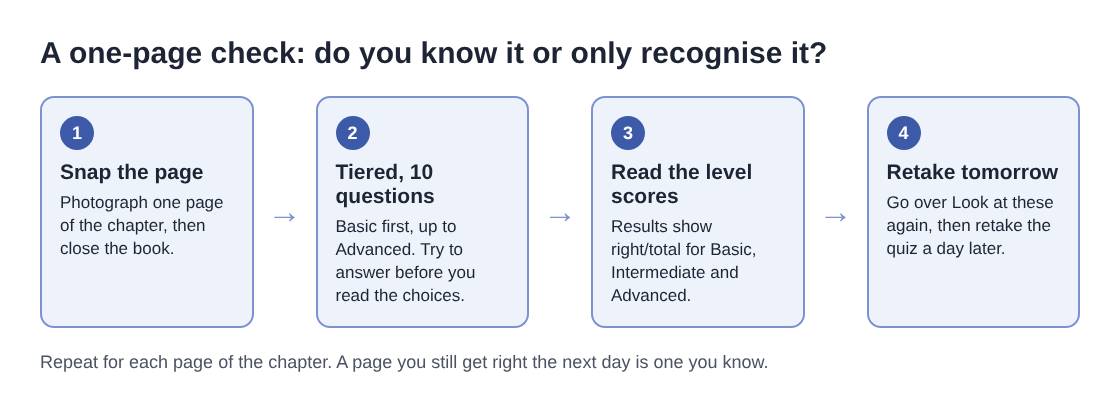
- In Study Shot, tap Make a new quiz, then Take photo. Hold the page flat and fill the frame.
- Leave the level on Tiered and choose 10 questions. Tiered is a ladder from Basic to Advanced. With 10 questions the app says you will get about 3 basic, 4 intermediate and 3 advanced.
- Press Create questions. It can take up to a minute.
Tiered suits this check because it covers all three ways of knowing in one quiz. Basic questions check key terms, facts and definitions. Intermediate questions ask you to explain, compare and connect ideas. Advanced questions ask you to apply and predict in new situations, which is close to the "change one detail" check. The guide on choosing a level and number of questions explains each option.
How to read your quiz results honestly
Don't open the page during the quiz. The Show page button shows your photo while you answer. It helps when you are learning. When you are checking yourself, it turns recall back into recognition.
Answer before you read the choices. Each question has four choices, and spotting the right one is easier than producing it. Cover the choices with your thumb, say your answer, then look. This is a suggestion, not a feature of the app.
Commit, then check. Pick an option and press Check answer. You will see Correct! or Not quite., the correct answer and a short explanation. Read the explanation even when you were right, in case you guessed.
Read the level scores, not just the total. Your results show a percentage, a grade and a score for each level. Say you get 3 of 3 on Basic, 3 of 4 on Intermediate and 1 of 3 on Advanced. As the results and retakes guide puts it, a high basic score with a low advanced one means you know the facts but not yet how to use them.
Work through your misses, then retake tomorrow. Look at these again lists each question you missed with Your answer and Right answer. Find where the page explains each one. Then press Retake quiz a day or two later; the same guide says getting it right after a break is a much better sign that you have learned it. Retakes use no credits.
One honest note: an AI model writes the questions, and they can contain mistakes. The explanation helps you check each answer against your page, and Report a problem with this question sits under every question. For more on misses, read how practice questions show what you do not know yet.
Frequently asked questions
Is rereading my notes a waste of time?
Not completely. A first read is how you take the material in. The problem is using rereading as your only check, because the page reminds you of everything while it is open.
How often should I test myself on a chapter?
Test each page the day you study it, then retake the quiz a day or two later. If your score holds up after the break, especially on the harder questions, that is a good sign.
Can I check myself without a teacher or tutor?
Yes. The blank page check, the two-minute explanation and a quiz taken without peeking all work on your own. What matters is producing the answer before you see it.
What if I can explain it but still miss questions?
Look at which level you missed. Misses on Advanced questions point to using the idea, so practise "what if" questions on that page and retake the quiz.
Get started
Pick one page from the chapter you are studying now. Close the book, write what you remember, then photograph the page and take a Tiered quiz without looking back. Your level scores will show where recognition ends. If this is your first quiz, the guide to making your first quiz takes you through every screen.
Try Study Shot: it is free to start. Photograph the page you are studying tonight and get practice questions on it, from basic to advanced, with every answer explained.