Open-Book Exam Prep: Should You Practise With the Book Closed?
Got an open-book exam coming? What two studies found about practising with the book open or closed, and a simple routine for quizzing yourself on each page.
An open-book exam sounds like the easy kind. You can bring the textbook, so why practise at all? Because having the book on the desk and knowing what is in it are not the same thing. Two studies that compared open-book and closed-book practice point the same way: practise with the book closed, and keep the book for checking. This post walks through what they found and gives you a routine you can run on one page tonight.
Open-book exam prep: the short answer
Yes, practice quizzes still help before an open-book exam. The more useful question is how you take them. In the studies below, practising with the material open scored higher at first, but it did not leave students better off later. In a university class it left them worse off.
So the advice is simple. Answer from memory first. Open the book only after you have committed to an answer, to check it and to find where the idea lives on the page. That way you get the practice of recalling and you still learn your way around the book you will bring to the exam.
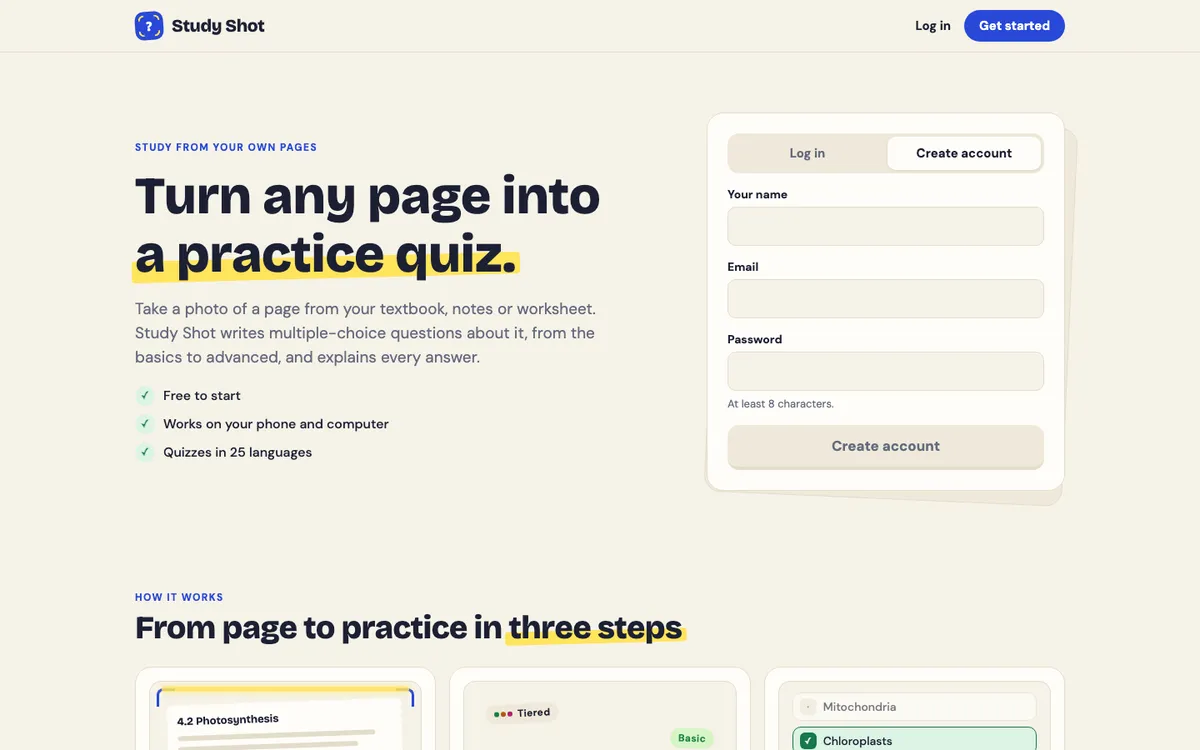
If you want quiz questions on the exact pages you are studying, Study Shot turns a photo of a page into a multiple-choice quiz and explains every answer. It is free to start and runs in the browser on a phone or a computer.
What two studies found about open-book practice
Here is what each study reports in its abstract. One was in a lab and one was in real university classes, so read them as two views of the same question.
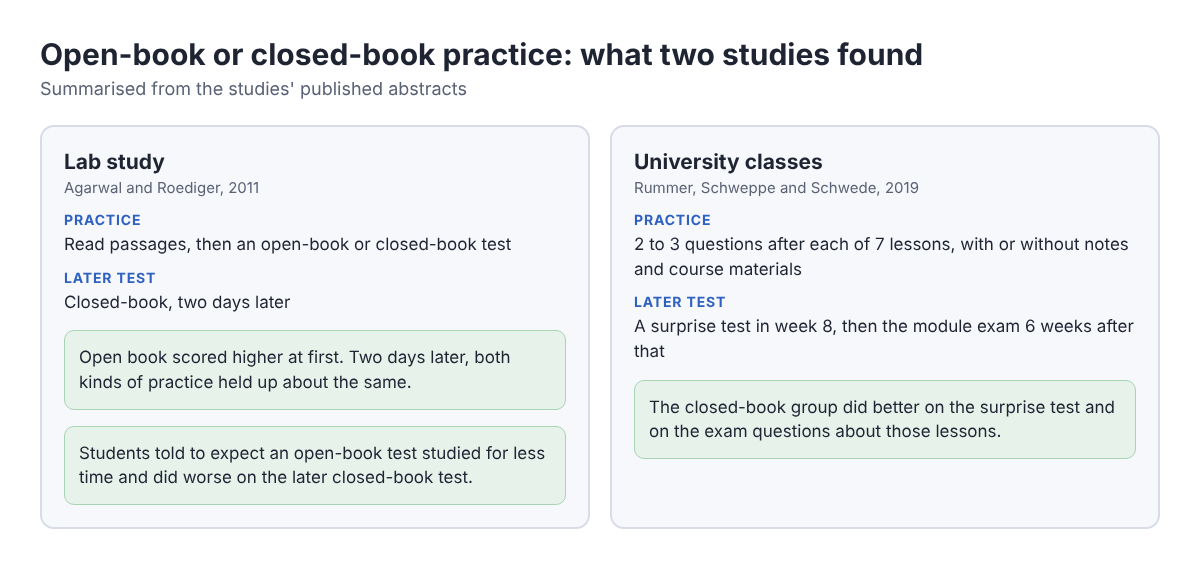
- A lab study (Agarwal and Roediger, 2011). Students read passages and then took a practice test either with the passage in front of them or without it. The open-book group scored higher on that first test. Two days later, on a closed-book test, both groups did about the same. In a second experiment, students who were told to expect an open-book test spent less time studying and did worse on the later closed-book tests, including questions that asked them to apply what they read.
- University classes (Rummer, Schweppe and Schwede, 2019). Two parallel introductory psychology courses got two or three questions in each of seven lessons. Half could use their notes and the course materials; half could not. The closed-book group did better on a surprise test in week eight, and again on the related questions of the final exam six weeks later. The authors name two possible reasons: the closed-book group got more retrieval practice, and the two groups may have been motivated differently.
Neither study is a test of an app, and neither had students sit a real open-book final. What they show is how the way you practise shapes what you keep. Looking things up while you practise gives you a better score now. Pulling answers from memory is what lasted.
Why an open book can quietly lower your effort
The second part of the lab study is the one to remember. Nothing about the practice changed. Students were only told what kind of test was coming. Those expecting an open-book test studied for less time and did worse on the later closed-book tests. The abstract also notes that students prefer open-book tests, which makes sense: they feel safer.
That feeling is the trap. When you know the book will be there, it is easy to skim a chapter, tell yourself you can look it up, and move on. Then on the day, every answer you have to hunt for costs time, and you may not know where to look. If your exam has a time limit, minutes spent flipping pages are minutes not spent writing.
It also changes what you notice. With the answer one glance away, you rarely find out what you could not have answered on your own. A closed-book quiz shows you that straight away. If you want more on that gap, read how to tell if you really know a chapter or only recognise it.
A worked example: one page, practised book-closed
Say your biology exam is open-book and one of the pages covers photosynthesis. Here is one way to practise it with Study Shot. The steps are a suggestion, built on the two studies above and on the app's own guides.
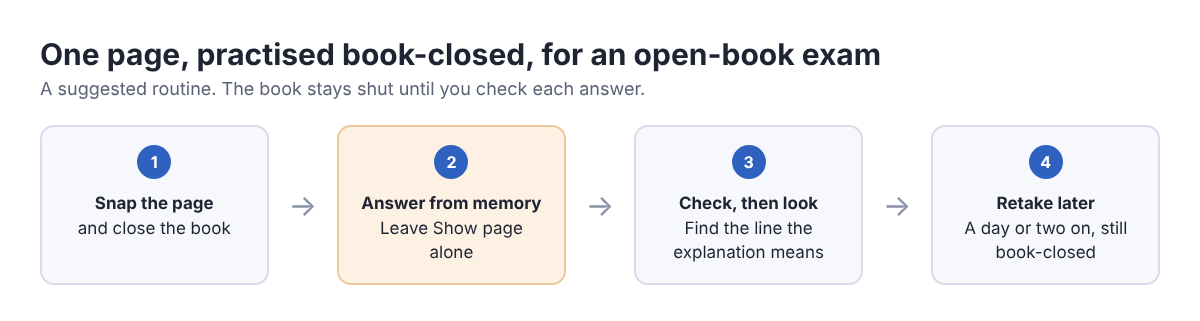
- Snap the page, then close the book. Take a photo of the page and create a quiz. For a first pass, pick Tiered with 10 questions; the levels guide suggests that for revising a chapter page by page. Tiered starts with basic questions and climbs to advanced ones.
- Answer from memory. A question like the one on the Study Shot home page asks where in a plant cell photosynthesis takes place, with four options such as in the mitochondria and in the chloroplasts. Before you look at the options, try to say the answer to yourself, as the explanations guide suggests. During a quiz, a Show page button brings your photo back. For this routine, leave it alone until you have checked your answer.
- Check, then look. Press Check answer. You see Correct! or Not quite., the correct answer, and a short explanation. The right answer only arrives after you check, so you cannot peek by accident. When you miss one, the guide's tip is to look at the page before you continue and find the line the explanation is talking about. This is where the open book earns its place: you are learning where that idea sits on the page.
- Retake later, still book-closed. Your results show a score for each level and a Look at these again list of the questions you missed. The results guide suggests retaking a quiz a day or two later, not just straight away. Do the retake without the page open, too.
If your basic score is high and your advanced score is low, the results guide reads that as knowing the facts but not yet how to use them. If your exam will ask you to use ideas, not only find them, that is worth a second quiz. Make a new quiz from the same photo with Advanced picked, which asks you to apply and predict in new situations.
Where the book helps in your practice
Closed-book practice does not mean ignoring the book. It means using it at the right moment. Here are three ways to use it well, all of them suggestions:
- After each check. Finding the line behind a missed answer teaches you the layout of the chapter, which is exactly what you need when you look something up on the day.
- To mark pages. As you retake quizzes, put a tab or a note on the pages behind the questions you keep missing. Those are the pages you may need to open on the day.
- To check the quiz itself. Questions are written by an AI model and can contain mistakes. If an explanation does not match your page, trust the page and use Report a problem with this question.
The core idea is not new to this blog. The testing effect explained for students covers why pulling an answer from memory tends to beat another read. An open-book exam does not change that. It only changes what you are allowed to bring with you.
How much time to give it
You do not need a long session. A 10-question quiz on one page is a small block of work, and you can spread pages across the days before the exam. A plan you could try, as a suggestion:
- Each study day: two or three pages, one quiz each, book closed while you answer.
- The next day: retake yesterday's quizzes from your library before you start new pages.
- The last day or two: retake the quizzes with the lowest scores, and switch the weakest pages to Advanced.
Retaking a quiz uses none of your monthly study shots, so the second and third passes cost nothing but time. If a page has only a little on it, the levels guide suggests 5 or 10 questions rather than 20.
Frequently asked questions
Do I need to study for an open-book exam?
Yes. In a lab study, students who expected an open-book test studied less and did worse on a later closed-book test. Knowing the material also saves time you would spend searching the book.
Should I take practice quizzes with my notes open?
It is better to answer from memory first and check your notes afterwards. In a university field study, students who practised without notes did better on a surprise test and on the related final exam questions.
Can Study Shot show me the page during a quiz?
Yes. Show page brings your photo back during a quiz, and Hide page puts it away. For closed-book practice, use it after you check an answer, not before.
What kind of questions does Study Shot write?
Multiple-choice questions with four answers, at Basic, Intermediate or Advanced level, or a Tiered mix of all three. Each answer is checked and explained as you go.
Get started
Try Study Shot: it is free to start. Photograph the page you are studying tonight and get practice questions on it, from basic to advanced, with every answer explained. Close the book, answer from memory, and open it only to check. That way the book you bring to the exam is one you already know your way around.