Short Answer Test: Do Multiple-Choice Practice Quizzes Help?
Got a short answer test coming? What three studies found about multiple-choice practice quizzes, and how to answer them so they train real recall.
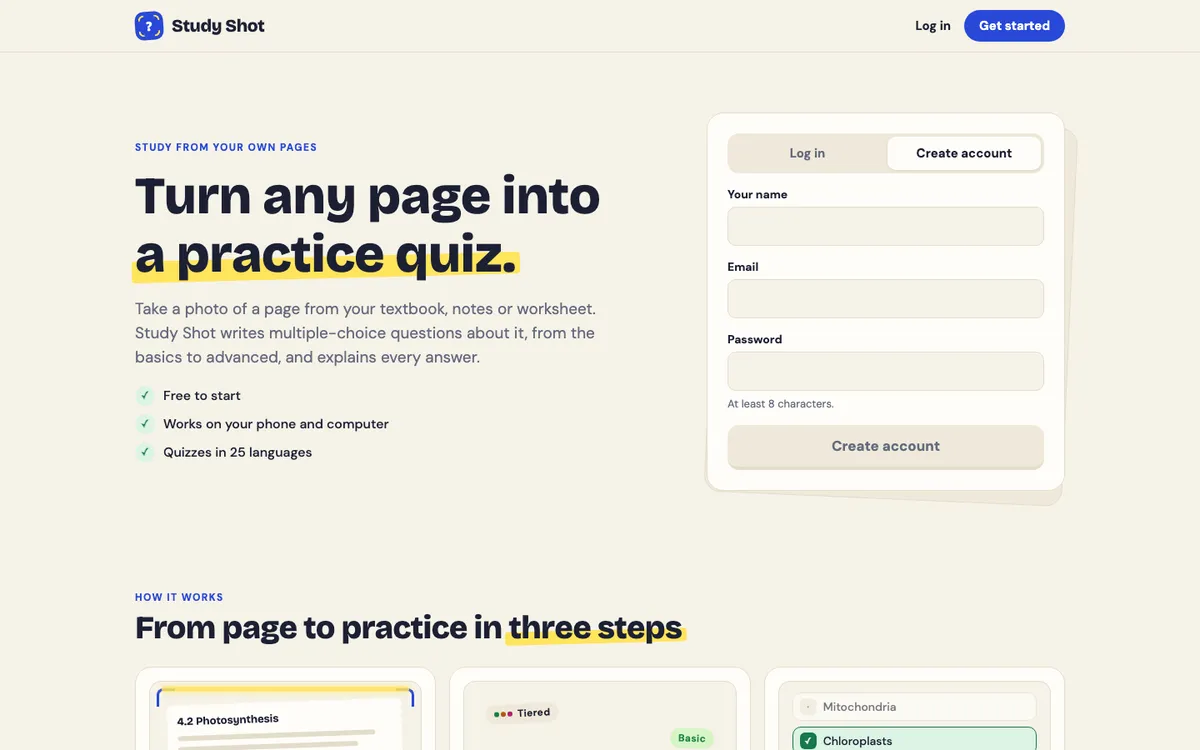
Your short answer test is coming, and the practice quizzes you have are multiple choice. Do they still help? The research says yes, with one useful tweak. In real classrooms, multiple-choice quizzes raised scores on later exams even when those exams used a different format. This post walks through three studies on quiz format, where multiple choice falls short, and how to answer a multiple-choice question the short-answer way. For the examples, we use Study Shot, which turns a photo of a page into a multiple-choice practice quiz.
The short answer: yes, multiple-choice practice carries over
A short answer test asks you to produce something from memory: a term, a reason, a step in a process. A multiple-choice quiz asks you to pick one of four options. Those are different tasks, so it is fair to ask whether practice on one prepares you for the other.
The clearest answer comes from real classes. When researchers quizzed middle and high school students in multiple-choice or short-answer format, the quizzed facts were remembered better on the unit exams and at the end of the semester, and the quiz format did not have to match the exam. So if your teacher writes short answer questions and your practice is multiple choice, the practice still counts.
The format still matters at the edges. Some studies found short-answer practice gave a bigger gain, and a blank line on a test gives you no options to lean on. The fix is simple: take each multiple-choice question as if it were short answer first, then use the options to check yourself.
What three studies found about quiz format
Here is what each study reports in its abstract. They used different students and materials, so read them as three views of one question, not one final number.
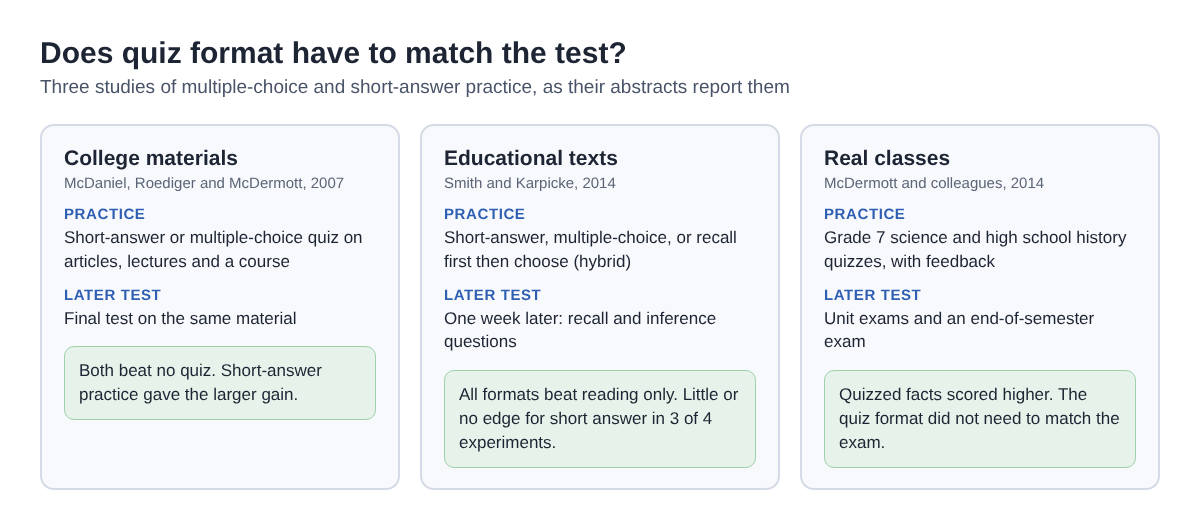
- College materials (McDaniel, Roediger and McDermott, 2007). Three experiments used brief articles, lectures and a college course. Taking a quiz helped in all three, and a short-answer first quiz gave bigger gains on the final test than a multiple-choice one. One experiment also found that feedback right after the quiz helped.
- Educational texts (Smith and Karpicke, 2014). In four experiments with 372 students, people read texts and practised with short-answer, multiple-choice or hybrid questions, where they tried to recall the answer first and then picked it from options. A week later, every format beat reading alone, on questions that asked for facts from the text and on questions that needed an inference. In three of the four experiments, short answer and hybrid had little or no edge over multiple choice. Short answer pulled ahead only in the experiment where students were helped to recall more of the answers during practice.
- Real classes (McDermott and colleagues, 2014). Seventh-grade science and high school history students took short quizzes, multiple choice or short answer, with the right answer shown afterwards. Quizzed facts scored higher than facts that were only taught, on unit exams and on an end-of-semester exam. The format of the quiz did not need to match the exam, and quizzing beat simply going over the facts again.
Put together: quizzing yourself beats rereading in every one of these studies. Short-answer practice can add a little, mostly when you can actually produce the answers. Multiple choice with feedback held its own in real classrooms.
Where multiple choice falls short before a short answer test
Multiple choice still has limits when the real test gives you a blank line. Know them so you can cover them.
- Recognising is easier than recalling. Seeing the right option and thinking "that looks familiar" is not the same as writing it from nothing. Four options give you cues the test will not.
- You do not practise the wording. Short answer questions often need the exact term or a clear sentence. Picking option C rehearses neither.
- A lucky guess feels like knowing. With four options, a guess is right some of the time. A blank line shows what you really know.
- You do not practise listing key points. Written answers are often marked on whether you include each point. A quiz does not train you to list them.
Study Shot writes multiple-choice questions only, each with four answers and one right one. It does not write short answer questions or mark written answers. The questions are written by an AI model and can contain mistakes, so the explanation after each answer helps you check, and Report a problem with this question sits under each one. What the app gives you is quick questions about your own page. You add the short answer part.
How to answer a multiple-choice question the short-answer way
This is close to the hybrid format in the Smith and Karpicke study: recall first, then choose. It works with any multiple-choice quiz.
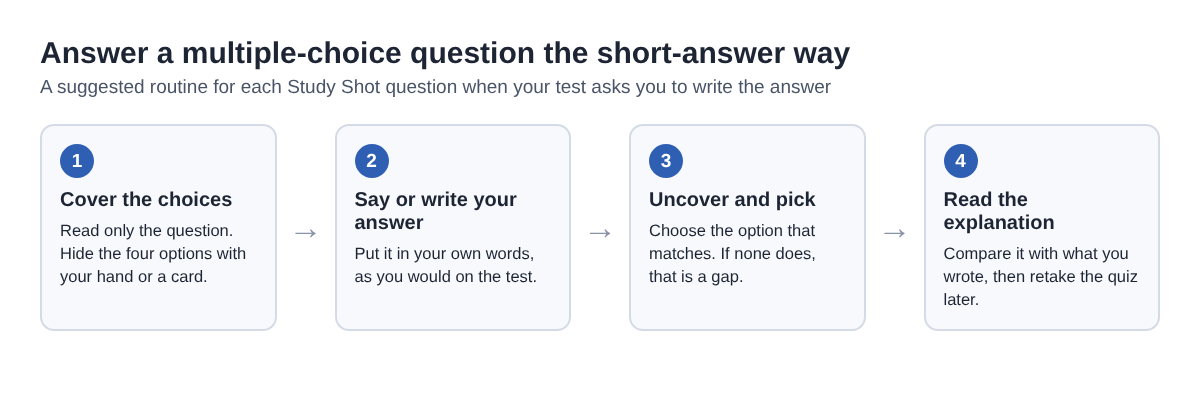
- Cover the options. Use your hand or a card. Read only the question.
- Answer in your own words first. Write one line on scrap paper, or say it out loud if you have no paper. Writing is closer to the real test.
- Uncover the options and pick. If your line matches an option, good. If none matches, you have found a gap.
- Compare with the explanation. Did your line include the key term? The key reason? Then rewrite what you missed in a full sentence, without looking.
Smith and Karpicke found short answer helped most when students could recall the answers. So if you cannot produce much yet, start with a quiz on the basics before you move to harder questions. For more on saying answers aloud, see does saying the answer out loud help you remember it.
Worked example: one biology page, short-answer style
Say your biology notes have a page on photosynthesis, and your test will ask questions like "Where does photosynthesis happen in a plant cell?" Here is one way through it.
- Open Study Shot in your browser on a phone or a computer, choose Make a new quiz, then Take photo or Choose photo. Hold the page flat and fill the frame; the guide on taking a good photo of a page has more tips.
- Pick a level and a number. Tiered, the default, climbs from Basic (key terms, facts and definitions) through Intermediate (explain, compare and connect ideas) to Advanced (apply and predict in new situations). Keep 10 questions, the default. The levels guide explains each one.
- Press Create questions. It can take up to a minute.
- Take the first question with the options covered. Suppose it asks where in a plant cell photosynthesis takes place. Write "in the chloroplasts" on your paper before you look.
- Uncover the four answers, choose the one that matches, and press Check answer. You see Correct! or Not quite., the correct answer and a one to three sentence explanation. If you wrote nothing, or wrote "mitochondria", that line is your gap.
- Need to check a detail? Press Show page to see your photo during the quiz.
At the end, the results show your score for each level and a Look at these again list, with Your answer and Right answer for each miss. Treat that list as your short answer to-do list: for each miss, close the screen and write the right answer as a full sentence. The quiz stays in your library with its page photo and best score, and retaking it uses no study shots. The results and retakes guide shows where everything is.
A 20-minute routine for a short answer test
This is a suggestion for one page of notes and one quiz. Adjust the times to your page.
- Minutes 0 to 2: set up. Photograph the page, keep Tiered and 10 questions, and press Create questions.
- Minutes 2 to 12: quiz with written answers. For each question, cover the options, write a one-line answer, then pick and press Check answer. Tick your line if it matched, cross it if not.
- Minutes 12 to 16: fix the misses. Open Look at these again. For each miss, read the right answer, look away and write it from memory.
- Minutes 16 to 20: blank page recall. Put the notes away and write everything you remember about the page. Then check it against your photo.
A day or two later, retake the same quiz the same way. In the classroom study, the quizzes were spread through the unit, not crammed at the end. If the test is tomorrow, the 30-minute night-before routine fits this approach.
Frequently asked questions
Does multiple-choice practice help on a short answer test?
In the classroom study by McDermott and colleagues, multiple-choice quizzes with feedback raised later exam scores even when the exam used another format. Writing your own answer before you look at the options makes the practice closer to the real test.
Is short-answer practice better than multiple choice?
Sometimes, a little. One study found bigger gains from short-answer practice, while another found little or no difference in three of four experiments; both beat rereading.
Can Study Shot write short answer questions?
No. Study Shot writes multiple-choice questions only, with four answers and one right one. You can turn them into short answer practice by covering the options and answering first.
What if a quiz question looks wrong?
Questions are written by an AI model and can contain mistakes. Check the explanation against your page, and use Report a problem with this question if something is off.
Get started
Try Study Shot: it is free to start. Photograph the page you are studying tonight and get practice questions on it, from basic to advanced, with every answer explained. Then cover the options, write your answer first, and you have short answer practice from a single photo.