The Night Before a Test: A 30-Minute Practice Routine
Short on time the night before a test? Follow this 30-minute practice routine to review smarter, find weak spots, and sleep well before exam day.
You have one evening left and a lot of pages. This is the night before a test: a 30-minute practice routine that replaces rereading with answering questions. It uses your own notes, a phone camera and a timer. You finish with a clear idea of what you know, what you do not, and time to sleep.
The night before a test: a 30-minute practice routine at a glance
Here is the whole plan in one place. The sections below explain each step.
- Minutes 0 to 5: pick the one or two pages that matter most.
- Minutes 5 to 10: photograph a page and turn it into a practice quiz.
- Minutes 10 to 22: take the quiz and mark what you miss.
- Minutes 22 to 27: go back over the misses and retake the quiz.
- Minutes 27 to 30: pack your bag and stop.
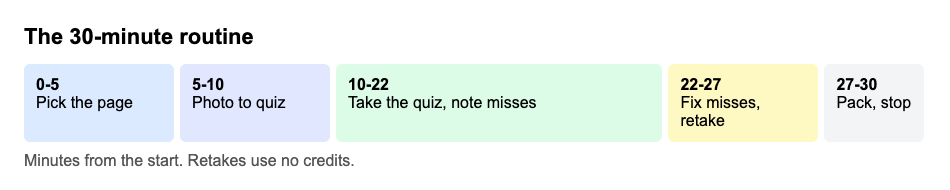
Set a timer for each block. The time limit is part of the routine. It keeps you from drifting into a long, comfortable reread.
Why practice beats rereading the night before a test
Rereading feels productive because the page looks familiar. When you read your notes, the answer is right there in front of you. In the test, it is not.
Answering questions forces you to pull the idea out of your head first. It also shows you where you are weak while there is still time to fix it. We cover the reasoning in the testing effect explained for students. For tonight, the short version is this: spend your 30 minutes answering, not looking.
Minutes 0-5: Gather your notes and pick what matters most
You cannot cover everything in 30 minutes, so choose. Open the test outline, the teacher's review sheet or the chapter headings. Then pick the one or two pages that carry the most weight.
Good candidates:
- A page the teacher said "will be on the test".
- A page full of definitions, formulas or steps you keep mixing up.
- A diagram page, such as a process with several stages.
- A page you skimmed in class and never revisited.
Write the page numbers on a sticky note. Then lay the pages flat, in good light, ready to photograph. If the test covers a whole chapter, you can work through it one page at a time. This post shows how to study a whole chapter one page at a time. Tonight, pick the page you are least sure about and start there.
Minutes 5-10: Turn your notes into a practice quiz
Now make the quiz. Open Study Shot in your phone or computer browser and log in. You need an account, and a new account starts on the Free plan.
Here is the worked example. Say you have a biology test on photosynthesis tomorrow, and page 3 of your notes is the one that worries you.
- Tap Make a new quiz, then Take photo (or Choose photo if you already have one).
- Hold the page flat and fill the frame. The guide to taking a good photo of a page has more tips. A flat, well-lit photo is easier to read.
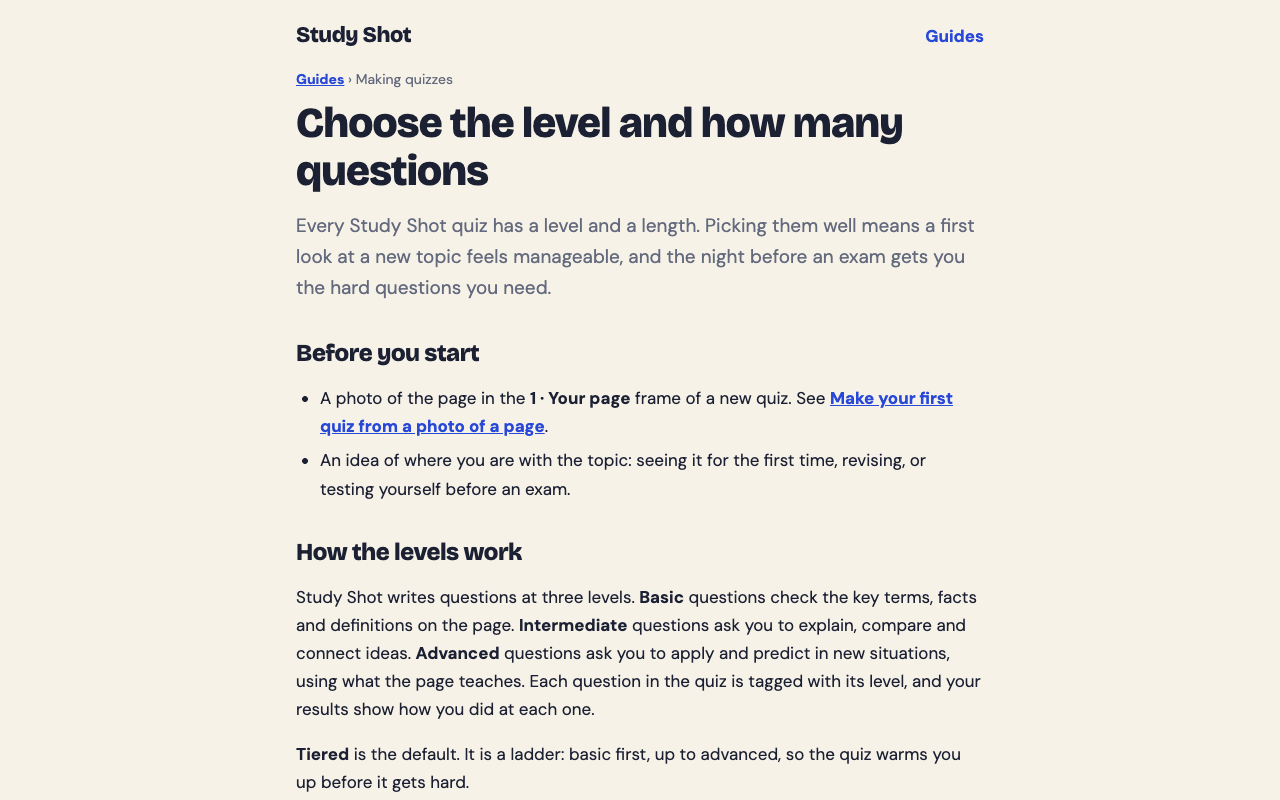
- Choose how many questions. For a 30-minute routine, 10 or 15 is a good fit. Ten is the default. You can pick 5, 10, 15 or 20.
- Choose a level. For tonight, Tiered is a sensible pick. It runs basic first and climbs up to advanced, so you check the facts before the harder "apply it" questions. If you already know the basics cold, choose Advanced and go straight to the hard ones. The guide to choosing a level and number of questions explains each option.
- Pick the quiz language if you want it in something other than English.
- Press Create questions.
Writing the questions can take up to a minute, so use that time to get a glass of water. Remember that a longer quiz uses more of your monthly credits. A 20-question quiz uses about four times what a 5-question quiz does. Taking a quiz and retaking it use no credits, so the routine below costs you nothing after the quiz is written.
If the app says it could not write questions for the photo, try a different page or retake the picture. It is better to find that out in minute 7 than in minute 25. For a fuller walkthrough of this step, see how to make a practice quiz from a photo on your phone.
Minutes 10-22: Quiz yourself and mark what you miss
This is the main block. You have about 12 minutes. For a 10-question quiz that is plenty. For 15, keep a steady pace of under a minute per question.
The rules:
- Commit before you check. Pick an option, then press Check answer. Do not peek at your notes first.
- Read the explanation, even when you are right. Each answer comes with a short explanation of one to three sentences. If you guessed correctly, the explanation tells you whether you really understood.
- Keep moving. Press Continue. Do not stop for five minutes on one question.
Keep a scrap of paper beside you. Each time you get one wrong, or guess right without being sure, write a two or three word label. For the photosynthesis page, that might be "where light reactions happen" or "what the Calvin cycle uses". These labels are your fix list for the next block.
The explanations help you check your own understanding. Still, the questions are written by an AI model and can contain mistakes. If something looks wrong, compare it with your textbook. You can also use Report a problem with this question under the question. Your textbook and teacher always win.
If you need to look back at the source, Show page displays your photo during the quiz. Use it only to settle a doubt after you answer, not before.
Minutes 22-27: Fix weak spots with a quick second round
When you press Finish quiz, you see a percentage and a grade. The grades run like this: Mastered at 90% and up, Good at 70% and up, Getting there at 50% and up, and Needs another try below that. Do not worry about the label. Look at the detail instead.
The results screen gives you a right and total score for each level in the quiz. If you took a Tiered quiz, you can see whether you lose points on basic facts or on the harder questions. That tells you what kind of fixing you need.
Then scroll to Look at these again. It lists each question you missed, with Your answer and Right answer. Use your five minutes like this:
- Spend about three minutes on the missed questions. Read the right answer, then find that idea on your page and say it out loud in your own words.
- Press Retake quiz and go through again, quickly. Retakes use no credits, and your best score is saved in your library.
- Check the questions that tripped you up the first time. If you now get them right without hesitating, they are fixed.
If you have a second weak page and a few spare credits, you can make a short 5-question quiz from it instead. Keep it small so it stays inside your five minutes. The guide to results, the library and retakes covers how scores and retakes work.
Minutes 27-30: Pack up and set yourself up for a good sleep
The last three minutes are not for studying. They are for removing tomorrow morning's problems.
- Pack your bag: pens, pencils, calculator, ID, water, anything the teacher said to bring.
- Put your notes and the sticky note with page numbers on top, so you can glance at them over breakfast if you want.
- Charge your phone and set your alarm.
- Close the quiz. Your quiz is saved in your library with its page photo and your best score, so it is there if you want a quick retake before class.
Then stop. You have already done the useful work, so go to bed on time.
What to skip the night before a test
Some habits eat the clock and give little back.
- Starting a new topic. If you never studied it, 30 minutes will not fix that. Go deep on the pages you already half know.
- Rewriting your notes. It looks neat and feels busy, but you are copying, not recalling.
- Highlighting everything. If the whole page is yellow, nothing stands out.
- Cramming past your bedtime. Another hour of tired reading is worth less than sleep.
- Making ten quizzes. One or two well-chosen pages, taken seriously, beat a pile you rush through.
Frequently asked questions
Is 30 minutes enough the night before a test?
It is enough to check your weakest page or two and fix the worst gaps. It will not replace weeks of study, but it is a better use of the time than rereading.
How many questions should I pick for this routine?
Ten or 15 fits the 12-minute quiz block. Study Shot offers 5, 10, 15 or 20 questions, with 10 as the default.
Which level should I choose?
Tiered works well if you are unsure, because it starts with basic questions and climbs to advanced. Choose Advanced if you already know the basics and want to practice applying them.
Do retakes cost credits?
No. Taking a quiz and retaking it use no credits. Only writing a new quiz uses credits from your monthly allowance.
Can I trust every question the AI writes?
Not blindly. The questions are written by an AI model and can contain mistakes, so use the explanations to check your own understanding and compare doubtful ones with your textbook. You can also report a problem with a question.
Get started
Tonight, pick your weakest page, set a timer and run the routine above. The guide to making your first quiz walks through the first one step by step.
Try Study Shot: it is free to start. Photograph the page you are studying tonight and get practice questions on it, from basic to advanced, with every answer explained.