Why Easy-to-Hard Questions Help You Learn (and How to Use Them)
Practice that is neither too easy nor too hard teaches fastest in one study. Here is what it found, what it left out, and how to climb from basic to advanced questions.
Why easy-to-hard questions help you learn is a fair thing to ask, because plenty of people start with the hardest questions and feel stuck. This post looks at what one published study says about training that is neither too easy nor too hard, is clear about what that study does not show, and then walks through climbing from basic to advanced questions with Study Shot, which turns a photo of a page into a multiple-choice practice quiz.
Why easy-to-hard questions help you learn: what the research says
The study behind this post is "The Eighty Five Percent Rule for optimal learning" by Wilson, Shenhav, Straccia and Cohen, published in Nature Communications in 2019. Its abstract is on PubMed (PMID 31690723), and everything below about the research comes from that abstract.
The authors looked at one variable, the difficulty of training, and how it affects the rate of learning. They report that in many situations there is a sweet spot where training is neither too easy nor too hard, and where learning progresses most quickly.
For the learning algorithms they studied, on binary classification tasks, they calculate that the best error rate for training is around 15.87 percent. Put the other way, the best training accuracy is about 85 percent. They show this for artificial neural networks used in AI and for biologically plausible neural networks that are thought to describe animal learning.
What this study does not show
It is worth being honest here. The abstract is about learning algorithms and models of animal learning. It does not describe an experiment on students answering multiple-choice questions, and it does not test whether putting easy questions first beats mixing them. So the 85 percent figure is not a target score for your quizzes.
What you can take from it is the general idea: practice that is far too easy or far too hard may teach less than practice in between. That idea is a reason to try a ladder of difficulty and watch your own results, not a promise about any score.
How a ladder of questions fits that idea
A ladder starts where you are likely to succeed and then raises the difficulty. Study Shot builds this into its levels. According to its guide to choosing a level:
- Basic questions check the key terms, facts and definitions on the page.
- Intermediate questions ask you to explain, compare and connect ideas.
- Advanced questions ask you to apply and predict in new situations, using what the page teaches.
Tiered is the default level. The guide describes it as a ladder, basic first, up to advanced, so the quiz warms you up before it gets hard. Study Shot splits the questions as evenly as possible across the three levels, in that order. If you want the full story on each level, read our post on why basic, intermediate and advanced questions matter.
How to climb from basic to advanced in Study Shot
- Photograph a page. Hold the page flat and fill the frame. The guide on taking a good photo of a page covers the details.
- Pick a number of questions. You can choose 5, 10, 15 or 20. The default is 10.
- Keep the level on Tiered. Under the numbers, the app says how many basic, intermediate and advanced questions you will get.
- Press Create questions. Writing can take up to a minute.
- Answer one question at a time. Pick an option, press Check answer, and read the explanation before you press Continue.
Questions are written by an AI model and can contain mistakes. Use the explanation to check an answer against your page, and use Report a problem with this question if something looks wrong. Our post on how accurate AI-written practice questions are covers what to watch for.
A worked example: one page, three levels
Say you photograph a textbook page on photosynthesis, choose 15 questions and keep Tiered. You get a quiz that climbs from basic to advanced. The three questions below are examples of the three levels, not real output from a quiz.
- Basic: Where in a plant cell does photosynthesis take place? You recall one fact.
- Intermediate: How does what chloroplasts do differ from what mitochondria do? You connect two ideas.
- Advanced: A plant is moved somewhere with much less light. What would you predict changes first, and why? You apply the ideas.
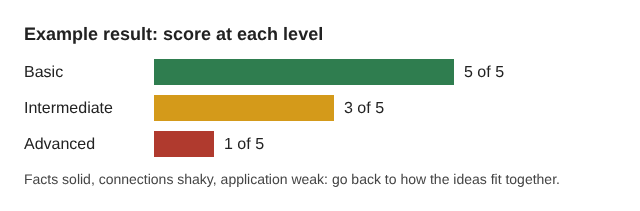
When you finish, the results show a score for each level. Imagine you got 5 of 5 on Basic, 3 of 5 on Intermediate and 1 of 5 on Advanced. Study Shot's results guide gives a clear reading of a pattern like that: if the advanced score is low and the basic score is high, you know the facts but not yet how to use them. So you go back to how the ideas fit together, not to the definitions.
Scroll to Look at these again to see each missed question with Your answer and the Right answer. Then press Retake quiz. The guide suggests retaking a day or two later, not only straight away. Retaking uses no credits, and our post on retaking a quiz until you master a page shows the loop.
When to skip the easy steps
A ladder is not always the right choice. The guide suggests Tiered for a new topic or a first look, and Advanced for the week before an exam, followed by retakes until you get the questions right. Basic suits learning definitions. Choose by what you need on that day.
If a page is new to you, going straight to Advanced mostly shows you that you do not know it yet. If you score full marks on Basic every time, you are mostly repeating what you know, so move up.
Common mistakes with difficulty
Reading one low score as a verdict
A low Advanced score tells you where to look. Check the Basic and Intermediate scores before you decide what to fix. The overall grade (Mastered at 90 percent and up, Good at 70, Getting there at 50, Needs another try below 50) can hide that pattern.
Skipping the explanations
On a miss, slow down and read the explanation. Here is more on why explanations after each answer help you learn.
Doing one pass and moving on
One run through the ladder shows where you stand. The missed questions are the ones to go back to. If you are short on time, the 30-minute routine for the night before a test fits a quiz and a retake into one session.
Frequently asked questions
Should I always start with basic questions?
No. Start with basic questions when the material is new. If you already know a page well, Study Shot lets you pick Advanced instead.
Is 85 percent the score I should aim for?
Not from this study. Its 85 percent figure is for learning algorithms in a model, and the abstract does not test students on quizzes. Use your level scores to see where you stand instead.
What does the Tiered level do in Study Shot?
Tiered is the default. It splits your questions as evenly as possible across basic, intermediate and advanced, in that order, so the quiz climbs as you go.
Does retaking a quiz cost credits?
No. Taking a quiz, retaking it, and taking a quiz someone shared with you use no credits. Writing a new quiz uses credits from your monthly allowance.
Get started with Study Shot
Try it on a page you are studying now: photograph it, keep Tiered, and see which level your score drops at.
Try Study Shot: it is free to start. Photograph the page you are studying tonight and get practice questions on it, from basic to advanced, with every answer explained.