Basic, Intermediate and Advanced Questions: Why Levels Matter
What basic, intermediate and advanced practice questions test, why a ladder of levels helps you spot gaps, and how to practise a page level by level.
Basic, intermediate and advanced questions: why levels matter comes down to one idea. Questions that are all easy can leave you feeling sure of yourself without testing much. Questions that are all hard can leave you guessing. Mixing the levels on purpose gives you a way to check both.
This post explains what each level tests, why it helps to move through them in order, and how to practise a page or chapter level by level using Study Shot.
Basic, intermediate and advanced questions: why levels matter and what each tests

The three levels do not just change how hard the wording is. They test different mental jobs. Study Shot describes them like this when you pick a level:
- Basic: key terms, facts and definitions. Can you recall what the page says?
- Intermediate: explain, compare and connect ideas. Do you understand how the pieces fit?
- Advanced: apply and predict in new situations. Can you use the idea on something the page never showed you?
Take a page about photosynthesis. A basic question could ask where in a plant cell photosynthesis takes place. An intermediate question could ask you to compare two stages of the process. An advanced question could describe a plant kept in a dark room and ask what you would expect to happen. These are examples of the kinds of question, not questions from the app. Same page, three different skills.
Why starting at one difficulty level holds you back
It is easy to practise only at the level that feels comfortable. The risk is that a test can ask for more than definitions. If you only ever practise recall, a "what would happen if" question may catch you out.
The opposite choice is jumping straight to hard questions. That can make sense when you already know the page, and the guide suggests Advanced for the week before an exam. On a new topic, starting with the basics lets you see what the page says first.
A mix that climbs gives you both: the quiz warms you up before it gets hard. That is why Study Shot's default level is Tiered, described in the app as "a ladder: basic first, up to advanced." It splits your questions as evenly as possible across basic, intermediate and advanced, in that order. The guide's example for 10 questions is about 3 basic, 4 intermediate and 3 advanced.
How basic questions build a foundation of recall
Basic questions are not a waste of time. They check that you hold the raw material: the terms, the facts, the definitions. Everything above them depends on this layer.
A good use for them is as a quick audit. Photograph a page, run a basic quiz, and see which terms you missed. Those misses are a short, concrete list of what to reread. Because each answer comes with an explanation of one to three sentences, you can fix the gap straight away instead of noting it for later. If you want to know why that step matters, read why explanations after each answer help you learn.
How intermediate questions teach you to apply and connect ideas
Intermediate questions ask you to explain, compare and connect. You cannot answer them by spotting a familiar word. You have to know what the word means and how it relates to the next idea.
Each question has four choices and one right answer, and the explanation after it tells you why. For more on using this format well, see why multiple-choice practice helps you learn and how to use it.
If you score well on basic but poorly on intermediate, that tells you something useful. You remember the facts but have not yet linked them. Reread the page looking for relationships: what causes what, what differs from what, what comes before what.
How advanced questions expose gaps and prepare you for exams
Advanced questions ask you to apply and predict in new situations. They are the kind of question the guide points to for an exam's harder questions, where you have to use what you know.
They also expose gaps that easier questions hide. You may recognise a definition and still fail to use it. Finding that out during practice is far better than finding it out in the exam room.
A wrong answer here shows you where your understanding stops. For what a study found about learning from errors, see why getting an answer wrong can help you remember it. One caution: questions are written by an AI model and can contain mistakes. The explanation helps you check the reasoning, and if something looks off, use Report a problem with this question. Our post on how accurate AI-written practice questions are covers what to watch for.
How to move up levels without getting discouraged
Your score will usually drop as the level rises. That is normal, not a sign you are failing. The results screen shows a right/total score for each level in the quiz, so you can see, for example, 4 of 4 on basic, 2 of 3 on intermediate and 1 of 3 on advanced. That is a map, not a verdict.
A few habits keep it from feeling heavy:
- Judge each level against itself. A weaker advanced score on a new page is expected.
- Use the Look at these again list on the results screen. It shows each missed question with your answer and the right answer, so you review only what you got wrong.
- Move up when the level below feels solid. Study Shot grades a quiz as Mastered at 90% and up, Good at 70% and up, Getting there at 50% and up, and Needs another try below 50%. Use those as signposts.
Retaking costs nothing. Taking and retaking a quiz uses no credits, so you can go back to a quiz whenever you want another pass. The post on how to retake a quiz until you master a page shows how to do that well.
A simple level-by-level practice plan for any page or chapter
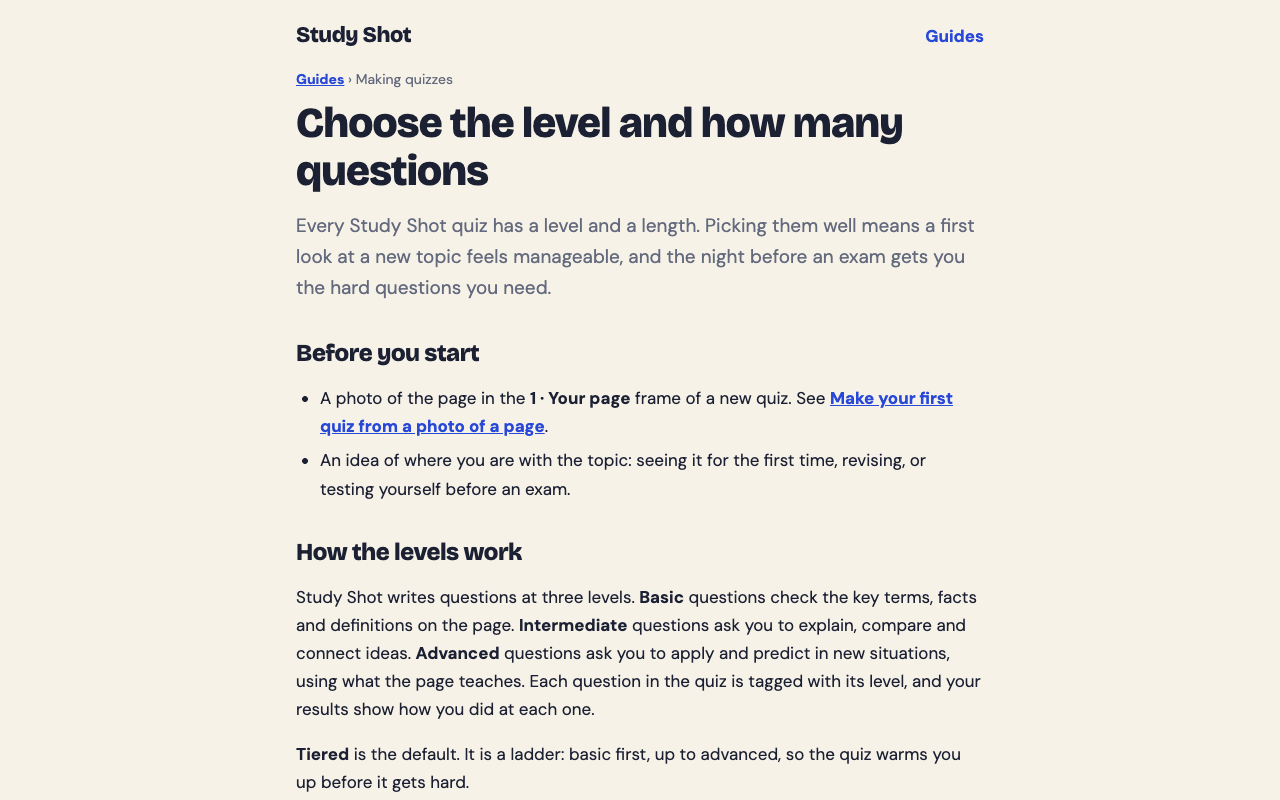
Here is a plan you can run on one page. It uses one photo and four quizzes. The level is chosen when a quiz is made, so each new level is a new quiz from the same photo.
- Photograph the page. Hold it flat and fill the frame. The guide on taking a good photo of a page has tips.
- Make a Basic quiz of 5 questions. Pick Basic as the level and 5 as the count. Read every explanation. Reread the page for anything you missed.
- Make an Intermediate quiz of 10 questions. Use the same photo. Focus on why the wrong options are wrong.
- Make an Advanced quiz of 10 questions. Treat misses as a list of ideas to rework, not as bad news.
- Finish with a Tiered quiz of 15 or 20 questions. This is your check. If the level scores on the results screen are close together, you are ready to move to the next page.
Writing a quiz uses credits, and a longer quiz uses more, so a 20-question quiz uses about four times what a 5-question quiz does. If you want to save credits, make one Tiered quiz and retake it, since retakes use no credits. The guide on choosing a level and number of questions explains the options.
For a whole chapter, repeat the plan page by page. The post on how to study a whole chapter one page at a time shows how to keep that manageable.
Frequently asked questions
Which level should I start with?
If you are unsure, start with Tiered, which is the default. It climbs from basic to advanced in one quiz, so you see where your strengths and gaps are.
How many questions can I ask for?
You can choose 5, 10, 15 or 20 questions. The default is 10, and each question has four choices.
Do harder levels cost more credits?
Writing a quiz uses credits, and how many depends on how many questions you ask for and how much is on the page. Taking and retaking a quiz uses no credits. The guide to credits and Study Shot Plus has the details.
Can I practise at a level in another language?
Yes. You can choose from 50 languages for the questions, answers and explanations. The app's own screens stay in English.
Get started
Try Study Shot: it is free to start. Photograph the page you are studying tonight and get practice questions on it, from basic to advanced, with every answer explained.