Why Students Forget What They Studied the Night Before a Test
Cramming feels solid at 10 p.m. but fades fast. See what studies on spacing and study habits found, and a plan with practice quizzes that sticks.
Why students forget what they studied the night before a test often comes down to this: the material was only ever familiar, never practised from memory, and it was learned in one block with no return visits. This post sets out what three research papers found about timing and about the feeling of knowing, then gives you a plan that uses your last days and your last night better.
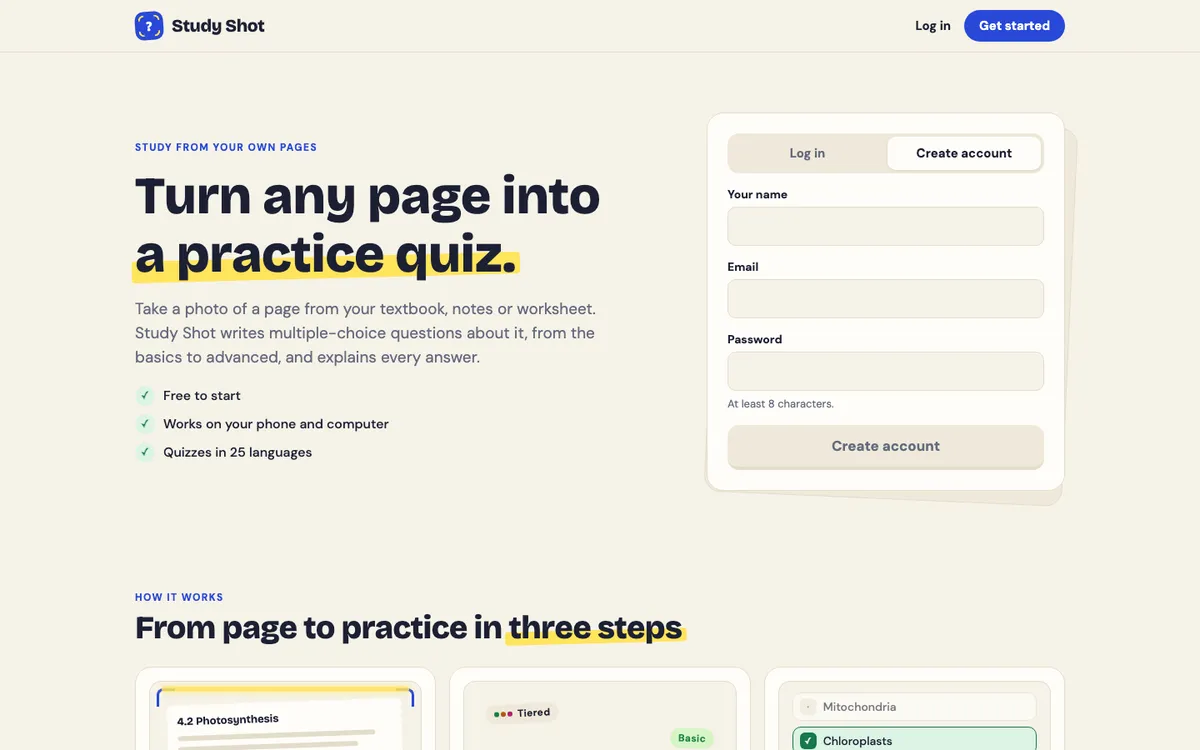
If you want to try the plan as you read, Study Shot turns a photo of a page into a practice quiz, so you can answer questions instead of rereading.
Why students forget what they studied the night before a test
Cramming feels like it works because the feedback is instant. You read a page, you recognise every line, and you think, "I know this." That feeling tells you the words look familiar right now. It does not tell you whether you can produce the idea tomorrow with nothing in front of you.
A test asks for the second thing. You get a question and a set of options, and you must decide from memory. If all your practice was looking at the page, you never practised that. And if everything was packed into one long block, you only met the material once, however many hours it took.
The studies below do not measure a student on a real exam night. They are experiments on timing and on how learning feels, and they report group results. They are a good reason to change your habit, not a promise about your next test.
What studies on spacing found
Researchers call studying in several sessions, with gaps between them, spaced practice. Studying everything in one block is massed practice, which is what cramming is.
In 2006, Nicholas Cepeda and colleagues published a meta-analysis of this effect. They gathered 839 assessments of distributed practice from 317 experiments in 184 articles, all using verbal recall tasks such as remembering lists and facts. One of their findings was that the gap between study sessions that gave the best final result grew as the time until the final test grew.
In 2008, Cepeda and colleagues ran a large study of their own. More than 1,350 people were taught a set of facts, given a review after a gap of up to 3.5 months, and tested up to a year later. A longer gap first raised the final score and then gradually lowered it. The best gap was larger when the test was further away. As a share of the wait until the test, it was about 20 to 40 percent of a one-week test delay and about 5 to 10 percent of a one-year delay. The authors concluded that many educational practices are highly inefficient.
For a student, the plain reading is this: if your test is a week away, a review a day or two after you first study is in the range those numbers point to, and a review the same evening is not a gap at all. The studies tested facts and word-style material, not every kind of exam, so treat the numbers as a direction and not a rule.
Why one long study session feels better than it works
There is a second problem. Massed study feels good.
Nate Kornell and Robert Bjork (2008) had people study paintings by different artists. For some, each artist's paintings came one after another (massed). For others, they were mixed in with other artists (spaced). Afterwards, the people were shown new paintings and had to say which studied artist painted each one. Spacing helped. Yet the people rated massing as the more effective way to study, even after their own test results showed the opposite.
That is a study of art, not of exam revision, so do not read it as proof about your biology notes. What it does show is that "this feels like it is working" can be a poor guide. If one long evening feels productive, that feeling alone is not evidence that you will remember on the day.
Rereading gives you familiarity, answering gives you recall
Most students cram by rereading and highlighting. A test does something different: it asks you a question and you have to answer from memory. The closest practice for that is answering questions before the test.
You can read a plain explanation of the research on that in the testing effect explained for students, and a comparison of the two methods in does answering questions beat rereading your notes. There is a second benefit as well: a wrong answer in practice shows you a gap while you can still fix it, which how practice questions show what you do not know yet covers.
A worked example with Study Shot
You can write your own questions, but that takes time you may not have. Study Shot writes them from a photo of a page. The questions are written by an AI model and can contain mistakes, so use the explanation to check your understanding against your book, and press Report a problem on a question that looks wrong. You can read more in this post on turning a textbook page into practice questions.
Say you have a biology chapter on photosynthesis.
- Photograph the key page. Hold it flat and fill the frame. The guide on taking a good photo of a page has more tips.
- Leave the questions at 10 and the level on Tiered, which starts with basic questions and climbs to advanced ones.
- Press Create questions and wait. It can take up to a minute.
- Answer one question at a time. After you press Check answer, you see whether you were right, the right answer and a short explanation.
If a question asks where in a plant cell photosynthesis takes place and you pick the wrong organelle, the explanation shows you why the chloroplast is right. You found that gap on day one, not in the exam room.
A plan that spreads your practice over days
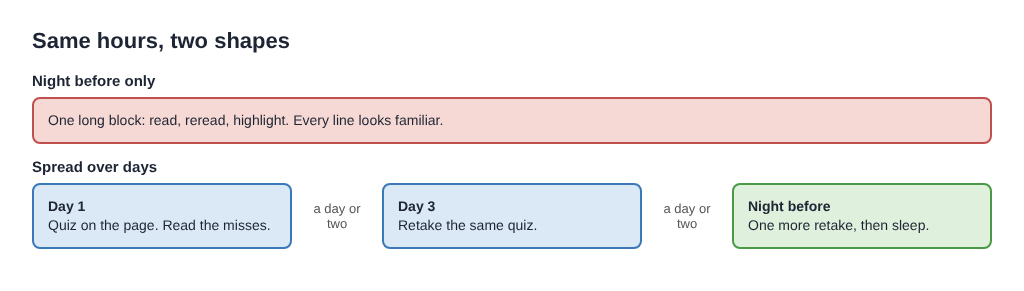
- Day 1: Photograph the pages you need and take a quiz on each. Treat the score as a map of what you do not know yet, not a grade.
- Day 1, after the quiz: Scroll to Look at these again. For each question you missed, it shows your answer, the right answer and the explanation. Restudy only those ideas from your book.
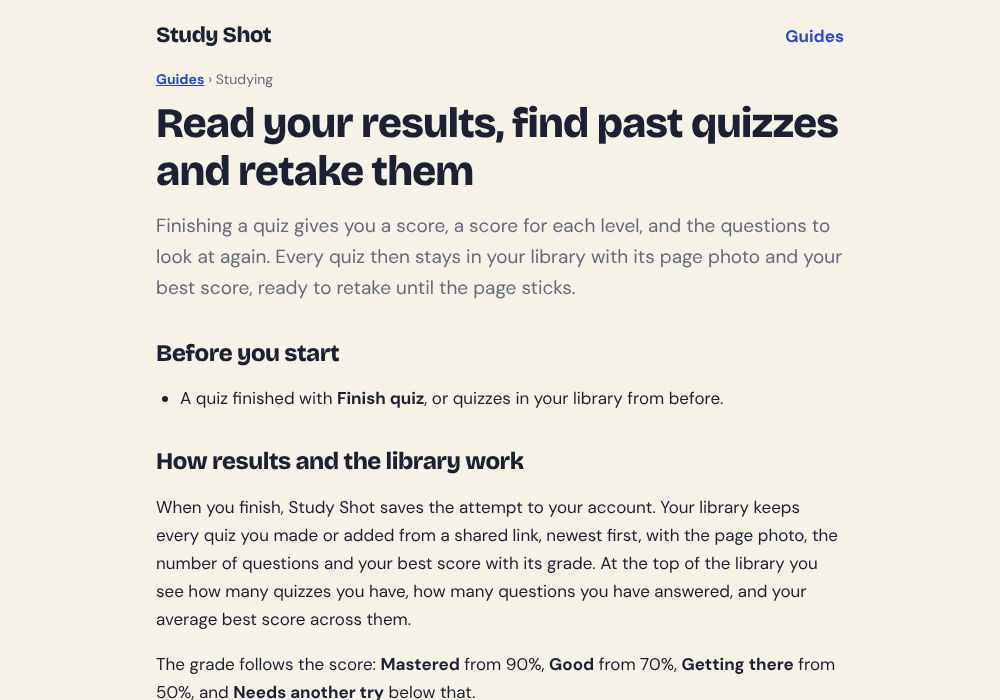
- Day 3 or so: Retake the quiz from your library. Retaking uses no credits. The results guide gives the same tip: retake a day or two later, not just straight away, because getting it right after a break is a much better sign that you have learned it.
- The night before: Do one more retake, or a quiz at Advanced level on your hardest page, then go to bed.
Your library keeps each quiz with its page photo and your best score, and the grade goes from Needs another try (below 50%) up to Mastered (90% and up), which gives you a target to aim for.
If you only have tonight
Then spend it on questions, not on rereading. Use the routine in the night before a test: a 30-minute practice routine: answer questions, find the misses, fix them, retake the quiz once more after a short break, then stop. A retake the same night is not the gap of a day or two that the studies above looked at, so start earlier next time.
Frequently asked questions
Is it bad to study the night before a test?
No. Reviewing the night before is fine, especially if you answer questions instead of only rereading. It is a poor time to meet the material for the first time.
Why do I blank out even when I studied?
One common reason is that you studied by rereading, so the page looked familiar but you never practised pulling the answer out. Answering questions before the test trains the skill the exam asks for.
How far apart should I space my study sessions?
One large study found the best gap grew as the test got further away, about 20 to 40 percent of a one-week wait for a test a week out. For a test a week away, that points to a review a day or two after you first study.
Does Study Shot guarantee I will remember everything?
No. It gives you practice questions with explained answers, and the questions can contain mistakes. How well you remember depends on how and when you practise.
Get started with Study Shot
Try Study Shot: it is free to start. Photograph the page you are studying and get practice questions on it, from basic to advanced, with every answer explained.
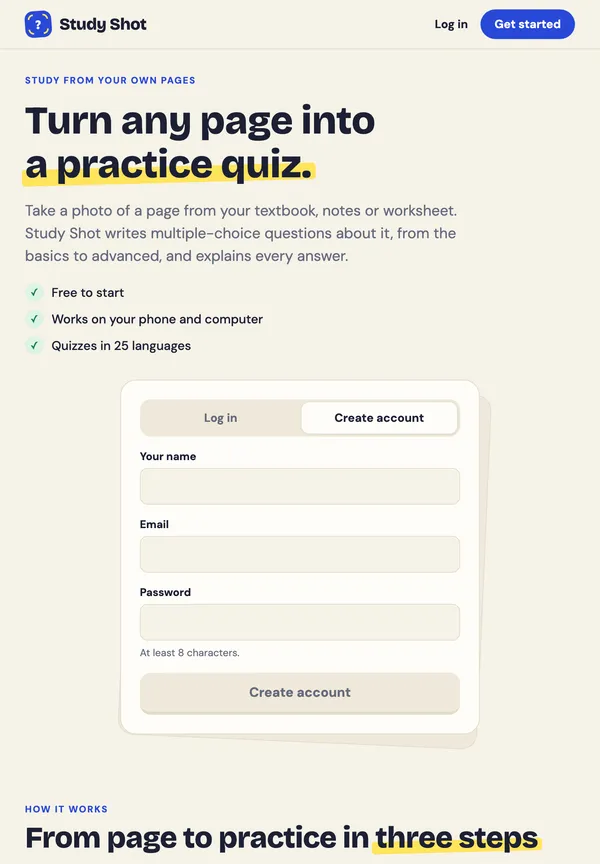
For a walkthrough of your first quiz, see the guide on making your first quiz.