How Tutors Can Turn Each Lesson Page Into a Quiz
A tutor's routine for turning a lesson page into a practice quiz: photograph the page, pick a level, use the explanations, and retake until the page is mastered.
If you tutor, you already know the problem. You cover a page with a student, they nod along, and a week later it is gone. This guide shows how tutors can turn each lesson page into a quiz in a few minutes, so every session can end with a check on what stuck. We will use Study Shot, a web app that turns a photo of a page into a multiple-choice practice quiz.
How tutors can turn each lesson page into a quiz
Explaining a page and a student answering questions about it alone are different things. A short quiz right after the page shows you which one you got, in the student's own answers.
It also gives you something concrete to act on. The results screen lists the questions a student missed, so you can spend the next few minutes on those instead of guessing.
Writing those questions by hand takes time you are not paid for. With a photo-based quiz tool, the page you already have in front of you becomes the question source. If you want the basic idea of how this works, read can AI make a quiz from a photo of my notes.
What you need before you start
- A phone or computer with a web browser. Study Shot runs in the browser, so there is nothing to install.
- A free account. The sign-in screen asks for your name, email and a password, and every screen needs an account.
- The lesson page itself: a textbook page, a handout, your own notes or a whiteboard.
Your students also need an account if you want them to take a quiz you shared. More on that in Step 5.
Step 1: Snap a photo of the lesson page

From your library, choose to make a new quiz, then Take photo or Choose photo. The app suggests you hold the page flat and fill the frame. Textbooks, notes, diagrams and whiteboards all work.
A few habits help (they come from the guide to a good photo):
- Photograph one page, or one clear section, per quiz, so the questions cover what you just taught.
- Keep shadows, glare and your fingers off the text. The app only writes questions about what it can see, so anything cut off or lost in glare does not make it into the quiz.
- Photos can be JPEG, PNG, WebP or GIF up to 5 MB. Large photos are shrunk before upload, so you do not need to resize anything.
For more on framing, see the guide on taking a good photo of a page. If a photo cannot be used, you will see "We couldn't write questions for this photo. Try a different page." Retake it with a cleaner shot.
Step 2: Generate questions from the page
Next, pick how many questions you want: 5, 10, 15 or 20. The default is 10. Then pick the quiz language. Questions, answers and explanations can be written in 50 languages, which helps if you tutor students who learn in a language other than English. The app's own screens stay in English.
Press Create questions. The app reads the page and writes the questions, and it can take up to a minute. Questions are multiple choice, with four options (A to D) and one right answer.
Here is a worked example. You are tutoring a middle schooler on a biology page about photosynthesis. You photograph the page, choose 5 questions, and get something like: "Where in a plant cell does photosynthesis take place?" with the chloroplasts as the right answer among four choices. This is an example, not a promise of which questions the app will write. It gives you a short check at the end of the session, built from the page you used.
Writing a quiz uses credits from a monthly allowance. A longer quiz uses more (a 20-question quiz uses about four times what a 5-question quiz does), so 5 questions is a light way to check a single page. Taking and retaking a quiz uses no credits. You can read the details in the guide to credits and Study Shot Plus.
Step 3: Mix basic, intermediate and advanced questions
The level you choose should match where the student is in the lesson.
- Basic: key terms, facts and definitions.
- Intermediate: explain, compare and connect ideas.
- Advanced: apply and predict in new situations.
- Tiered (the default): a ladder that goes from basic up to advanced, with the questions split as evenly as possible across the three levels.
A simple rule for tutors: use Basic on a brand new page, Tiered once the student has seen the material, and Advanced before a test. The results screen shows a right and total score for each level, so you can see whether a student knows the vocabulary but struggles to apply it. That is a very different problem from not knowing the vocabulary at all.
To understand why this ladder helps, read why easy to hard questions help you learn and why levels matter. The guide on choosing level and number of questions covers the settings step by step.
Step 4: Use explanations to teach after each answer
The student picks an option and presses Check answer. The app says Correct! or Not quite, shows the right answer, and gives a short explanation of one to three sentences. Then they press Continue, and the last question says Finish quiz.
This is where you come in. Do not let the student rush past a wrong answer. A simple habit is to ask them to read the explanation aloud, then say it back in their own words. If they cannot, that is a topic for the next minutes of your session.
During the quiz, Show page displays the photo, so you can point to the exact line in the text that answers the question. For why this habit works, see why explanations after each answer help you learn.
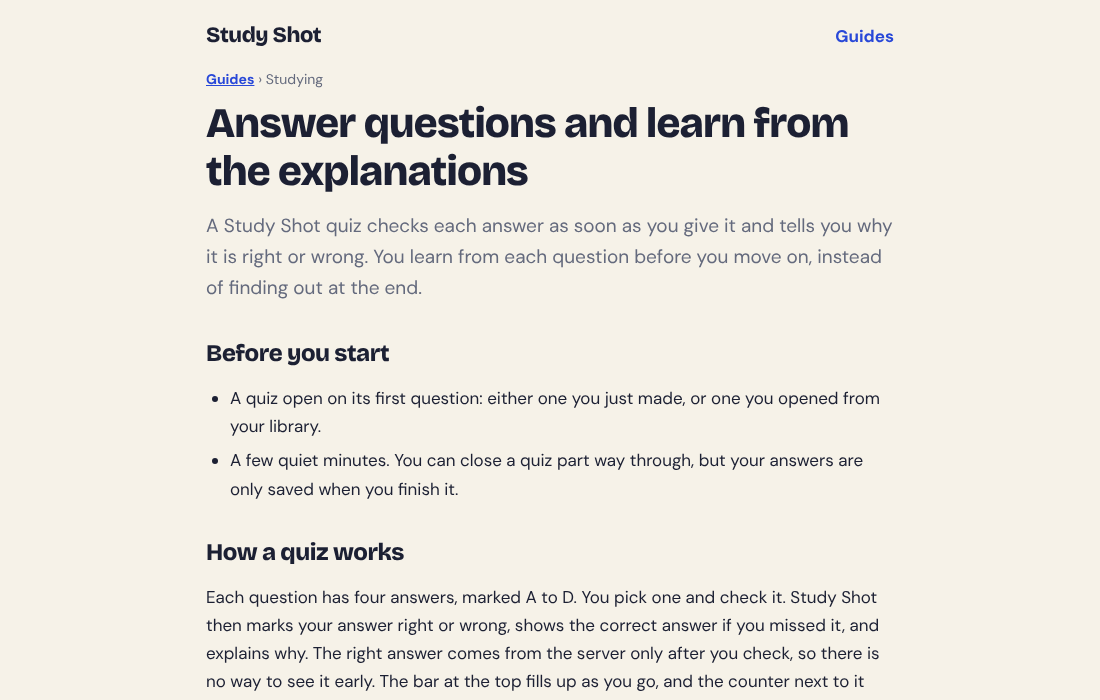
One honest note: questions are written by an AI model and can contain mistakes. Treat the explanation as something that helps you check the answer against the page, and use your own judgment as the tutor. If a question looks wrong, use Report a problem with this question under it and pick one of four reasons.
Step 5: Have students retake the quiz until they master the page
When the quiz ends, the results screen shows a percentage and a grade:
- Mastered: 90% and up
- Good: 70% and up
- Getting there: 50% and up
- Needs another try: below 50%
It also lists the questions the student missed under Look at these again, with their answer next to the right answer. Walk through that list together before moving on.
Every quiz is saved in the library with its page photo and the best score, so a student can press Retake quiz at any time. Retakes use no credits. A sensible target for tutoring is Mastered on a page before you start the next one. The full routine is in how to retake a quiz until you master a page, and the guide on results, library and retakes shows the screens.
If you want a student to practise between sessions, use Share this quiz. It makes a link. The student opens it with their own Study Shot account and gets their own copy of the questions, without your photo. You can Stop sharing at any time. Taking a quiz someone shared with you uses no credits. See sharing a quiz for the steps.
Tips for tutoring different subjects and ages
- Whole chapters: work one page at a time and build a quiz per page. The post on studying a whole chapter one page at a time lays out the pattern.
- Short sessions: a 5-question quiz at Basic or Tiered fits the end of a short lesson.
- Exam prep: go to 15 or 20 questions at Advanced, using the pages the student finds hardest.
- Language learners: pick the quiz language that fits the student, so questions and explanations are in a language they can read.
- Diagrams and whiteboards: photograph the board at the end of the lesson so the quiz matches what you actually drew and said.
- Parents involved: send them the guide on making a practice quiz from homework so practice continues at home.
Study Shot is multiple choice only, so for subjects where students must write or show their working, treat the quiz as a check on concepts and keep the written practice in your own sessions.
Frequently asked questions
Can I make a quiz from my own notes or a whiteboard?
Yes. Notes, handouts, textbook pages, diagrams and whiteboards all work, as long as the photo is clear and the page fills the frame.
Do my students need an account?
Yes. Every screen in Study Shot needs an account. A student who opens your shared link signs in and gets their own copy of the questions, without your photo.
Does retaking a quiz cost credits?
No. Taking a quiz, retaking it, and taking a quiz someone shared with you use no credits. Only writing a new quiz uses credits from your monthly allowance.
What if a question looks wrong?
The questions are written by an AI model and can contain mistakes. Check the question against the page, and use Report a problem with this question to flag it.
Get started
Try Study Shot: it is free to start. Photograph the page you are studying tonight and get practice questions on it, from basic to advanced, with every answer explained.